The Binary Acoustics 1900 is an interesting IEM because it takes a fairly ambitious approach to its driver configuration without losing sight of what matters most when listening: how naturally music comes together. Its configuration combines a 10mm dynamic driver and a 6mm passive radiator for the low frequencies with four balanced armatures handling the rest. On paper, that is a serious setup for an IEM around the $235 price point, but the 1900’s appeal is less about the driver count and more about the way it handles vocals, midrange detail and bass control.
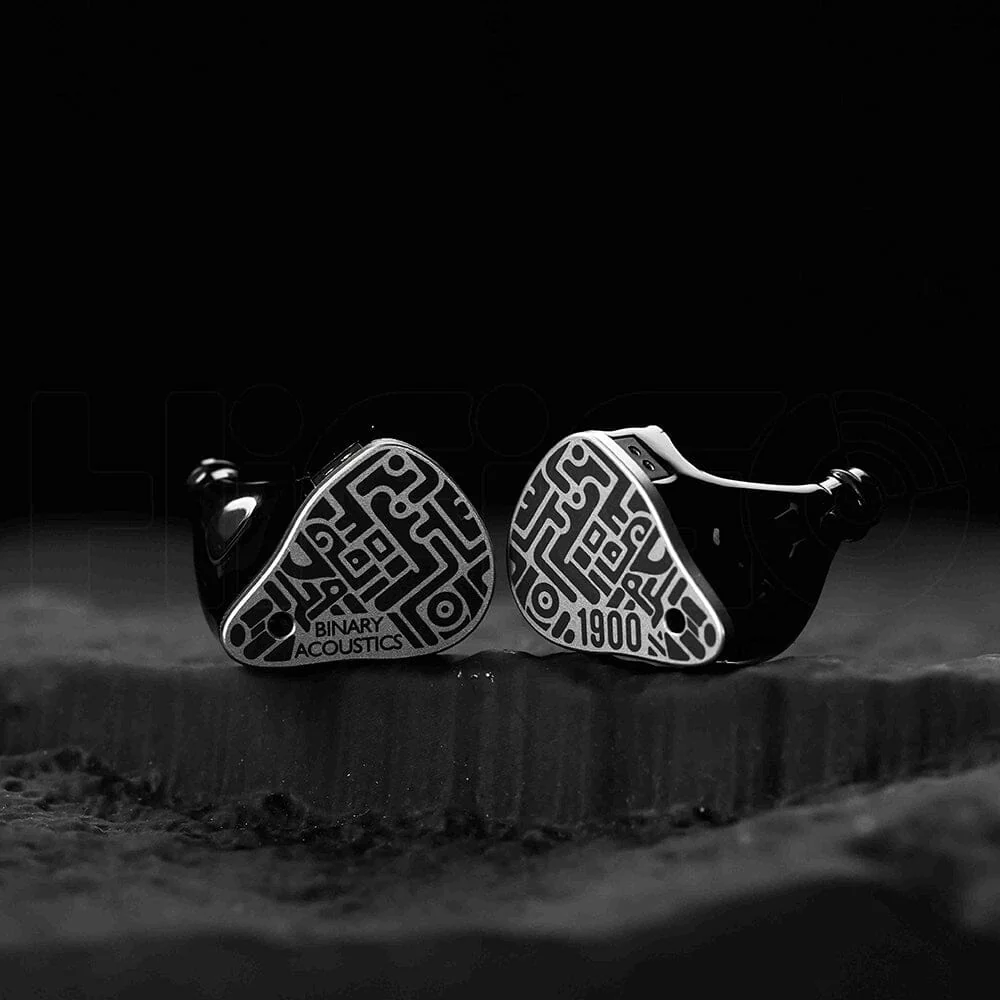
Binary Acoustics 1900
What immediately stands out to me is that the 1900 is not trying to win by simply throwing more bass at the listener. The sub bass is relatively restrained, while the mid bass has considerably more authority. Kick drums have punch, bass lines remain easy to follow, and the rhythm section has a clean separation that helps busy arrangements stay organized. That character becomes particularly obvious with progressive and fusion recordings where bass and drums have to work together rather than simply provide background weight.
The 1900 also has a strong vocal and midrange presentation. Male vocals have a solid foundation, while the overall tuning retains enough warmth to prevent voices and instruments from becoming excessively thin. Detail retrieval is another strength, making this an IEM that rewards well recorded material. At the same time, its presentation can expose poor mastering, and the restrained sub bass means listeners looking for a visceral low end experience may find it less exciting.
For me, that combination makes the Binary Acoustics 1900 a specialized but compelling option. It is at its best when the goal is clarity, natural timbre, strong vocals and controlled bass rather than maximum sub bass impact.
Unboxing and First Impressions
The Binary Acoustics 1900 arrives in a presentation that feels appropriate for an IEM at this level. The earphones and cable are nestled into foam, with a selection of ear tips provided in a separate box. Underneath the foam, there is also a sizable storage case that has enough room for the IEMs and a dongle DAC, which makes it considerably more useful than a case that only accommodates the earphones.
The first impression is helped by the appearance of the IEM itself. The 1900 looks gorgeous straight out of the box, and the faceplate gives it a distinctive visual identity. The package is not revolutionary, but it covers the essentials without making the unboxing experience feel bare.
The included cable is the weaker part of the package. It does the job, but it feels somewhat inexpensive for an IEM in this price range, and a modular design would have made the package more flexible. Fortunately, the 1900 uses a standard 0.78mm 2-pin connection, so replacing the cable is straightforward. The included tips are usable, although they do not stand out as a major strength of the package.
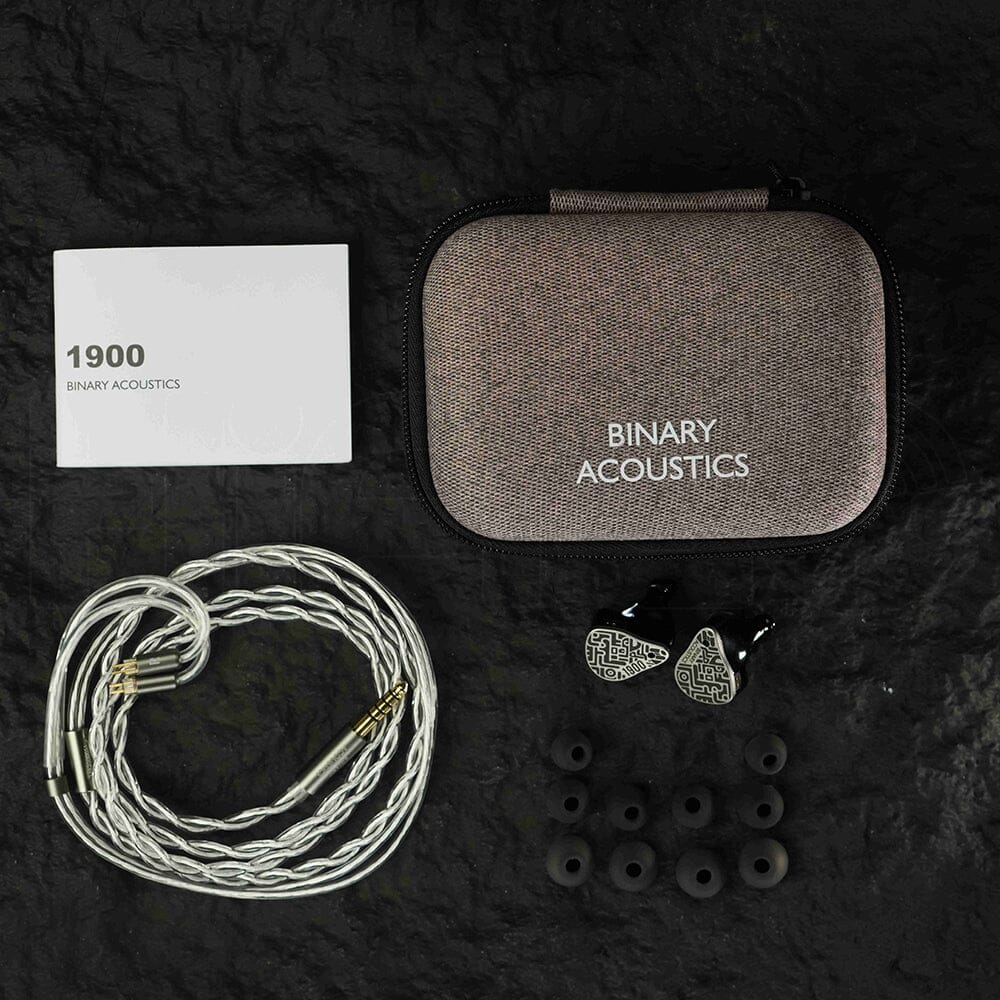
Binary Acoustics 1900 Accessories
Build Quality and Design
The 1900 has a polished, attractive design that makes a strong first impression. The faceplate pattern gives the earphone a distinctive look, and the overall construction feels much more premium than the basic cable included in the box. The detachable 0.78mm 2-pin connectors are a practical choice, with clearly marked left and right indicators that make channel identification simple.
The nozzle is approximately 6mm and uses a three-hole design. That is a fairly substantial nozzle, so tip selection matters when finding the right fit. I find the overall design reasonably comfortable for longer listening sessions, although the small lip on the shell can become something of a love and hate feature depending on how the earphone sits in the ear. The fit is slightly better than the EP321 in the available comparison, although comfort remains dependent on ear shape and tip choice.
The cable is where the 1900 feels less convincing. It is functional, but its quality does not quite match the ambition of the earphones themselves. I would have preferred a better cable, particularly at roughly $235, and a modular termination would have added useful flexibility. Still, the standard 2-pin connection means this is easy to address without replacing the IEM itself.
The storage case is another practical positive. It is large enough to hold the IEMs together with a dongle DAC, so it can function as a genuine portable accessory rather than simply protecting the earphones between listening sessions. Overall, the physical package succeeds because the actual IEM design is attractive, practical and reasonably comfortable, even if the cable leaves room for improvement.
Sound Quality
The Binary Acoustics 1900 has a sound that prioritizes mid bass authority, vocal quality and detail rather than an exaggerated sub bass presentation. I find the overall balance neither particularly dark nor excessively bright, with enough warmth to give instruments and voices weight while preserving a clear and resolving character. The tuning becomes especially convincing with well recorded material, where its ability to separate individual elements can make complex arrangements easy to follow.
Bass
Bass is one of the more interesting aspects of the 1900 because its strengths and limitations are concentrated in different parts of the range. The mid bass is beautifully controlled, with punchy kick drums and authoritative bass lines that extend naturally toward the low mids without excessive bleed or bloat. The separation between kick and bass is particularly good, and individual notes remain easy to distinguish.
Tracks such as “Got A Match” by the Chick Corea Elektric Band and “YYZ” by Rush benefit from this presentation. The kick and bass work together to hold the rhythm section in place, while the bass remains sufficiently controlled to avoid overwhelming the rest of the arrangement.
The sub bass is a different story. I find it relatively tame, and the passive radiator does not turn the 1900 into a deeply rumbling bass monster. Very low frequency notes can lack the physical impact and emotional weight that some listeners expect. Bass guitar remains clear, but the presentation can sound more immediate than deeply resonant, and the amount of slam is somewhat reduced.
A small bass shelf through EQ can help if I want more low end presence. More power and Final E tips can also improve the overall result. The important point is that the 1900 already has excellent bass control; what it lacks is primarily sub bass intensity rather than definition.
Midrange
The midrange is one of the strongest reasons to consider the 1900. Vocals have good presence and natural weight, with male voices receiving a particularly solid foundation. There is also enough warmth to prevent instruments and vocals from sounding skeletal or overly thin.
I especially like the way the 1900 combines vocal clarity with detail retrieval. It can bring subtle information forward without making the presentation feel inherently clinical. That makes it particularly attractive for vocal driven music, acoustic recordings and arrangements where the character of the singer or individual instruments matters.
At the same time, the 1900 is revealing enough to expose poor mastering and rough recordings. Well produced music can sound clean and engaging for long periods, while badly mastered tracks are less forgiving. With good recordings, vocal transients avoid obvious graininess, harshness or excessive hotness.
Treble
The treble presentation is more nuanced. I find the 1900 capable of sounding refined and relatively neutral through the highs, but it can also come across as somewhat sharp depending on the recording and source. That sharpness does not necessarily translate into a proportional increase in perceived detail, so the 1900 is not an IEM I would choose specifically for an aggressive treble forward presentation.
The upside is that the treble does not consistently become harsh or abrasive. With well mastered material, the overall presentation can remain comfortable and relatively fatigue free. Source pairing matters, however, and a neutral or bright source can make the character less appealing than a source with a little more warmth.
Technical Performance
Detail retrieval is one of the 1900’s standout qualities. Complex passages remain organized, and the rhythm section benefits from clear separation between individual bass and kickdrum notes. Its natural timbre is another important strength, particularly when comparing it with technically stronger alternatives where the 1900 can still sound more natural or musically convincing.
The technical picture is not completely straightforward, for example, the Binary Acoustics EP321 can be technically more capable in some respects. For me, the useful takeaway is that the 1900’s technical performance should not be judged by detail alone. Its natural presentation and strong separation are major parts of its appeal, while absolute technical performance is not necessarily its defining advantage.
How It Compares
The Binary Acoustics 1900 occupies an interesting position against alternatives because its strengths are not limited to raw technical performance. Compared with the EP321, I find the 1900 slightly better in terms of fitment, which makes it easier to settle into longer listening sessions. The EP321 MEMS, however, has an advantage in technical capability.
What keeps the 1900 competitive is its natural timbre. Even when the EP321 can deliver more technically capable performance, the 1900’s presentation has a more natural character that I find particularly appealing with vocals and instruments. That difference matters because technical ability is only part of what makes an IEM enjoyable to listen to.
The 1900 also takes a different approach to bass. Its sub bass is relatively restrained, but its mid bass has excellent control and separation. That gives kick drums and bass lines a clean, authoritative character without turning the presentation into a bass heavy one.
For me, the comparison with the EP321 highlights the 1900’s identity quite well: the EP321 is the more technically ambitious choice, while the 1900 makes a stronger case through natural timbre, vocal quality, fitment and musical coherence. If I prioritize technical performance above everything else, the EP321 has the advantage. If I want a more natural and engaging presentation, I would lean toward the 1900.
Is It Right for You?
The Binary Acoustics 1900 makes the most sense for listeners who care strongly about vocals, midrange quality and controlled bass. It is particularly well suited to vocal heavy music, progressive rock, jazz fusion and recordings where the interaction between bass, drums and other instruments is important.
I would also consider it a good step beyond entry level IEMs for someone who wants to explore a more refined presentation without immediately moving toward an aggressively technical or bass heavy tuning. Its detail retrieval gives it enough resolution to make that transition worthwhile, while its natural timbre keeps the presentation from becoming sterile.
Bassheads should approach it differently. The mid bass is punchy and controlled, but the sub bass is comparatively restrained. If the main attraction is physical rumble and deep slam, the 1900 is unlikely to be the ideal choice.
I would also pair it carefully with the source. A neutral or bright source can make its upper range less forgiving, while a little EQ and appropriate tips can help tailor the sound. Listeners who are comfortable making small adjustments have more room to get the 1900 working exactly the way they want.
For me, its ideal audience is someone who puts vocals, natural timbre, bass control and detail ahead of extreme bass quantity or maximum treble energy.
Final Verdict
The Binary Acoustics 1900 is an IEM with a clear identity. Its strongest qualities are excellent mid bass control, convincing vocals, strong midrange detail, attractive construction and a natural overall timbre. The 10mm dynamic driver, passive radiator and four balanced armatures create an ambitious platform, but the real success is how the 1900 uses that configuration to keep complex music organized.
Its weaknesses are equally clear. The sub bass is restrained, the included cable feels underwhelming for the price, and the treble can become sharper with certain recordings or sources. It is also revealing enough that poor mastering can take some of the pleasure out of listening.
Even with those limitations, I see the Binary Acoustics 1900 as a strong choice for listeners who prioritize vocals, midrange quality and controlled bass. A little EQ, a suitable source and the right tips can make it even more flexible. If deep sub bass or maximum technical performance is your primary goal, I would look elsewhere. If you want a detailed, natural sounding IEM that gives vocals and the rhythm section real attention, the 1900 deserves serious consideration.
Where to Buy
You can find the Binary Acoustics 1900 on:
Affiliate Disclaimer: Listen Vibes may earn commissions from qualifying purchases that helps to maintain the website - at no extra cost to you.