It’s not often I come across an IEM that feels immediately comfortable in my ears, both in terms of fit and sound. But from the moment I pressed play with the - EPZ P50, something immediately felt right. EPZ has been steadily building a reputation for well-built, great-sounding gear that doesn’t break the bank, and the P50 continues this tradition with a sophisticated blend of musicality and technical prowess. Let me take you through my full impressions after spending serious time with this elegant little tribrid.
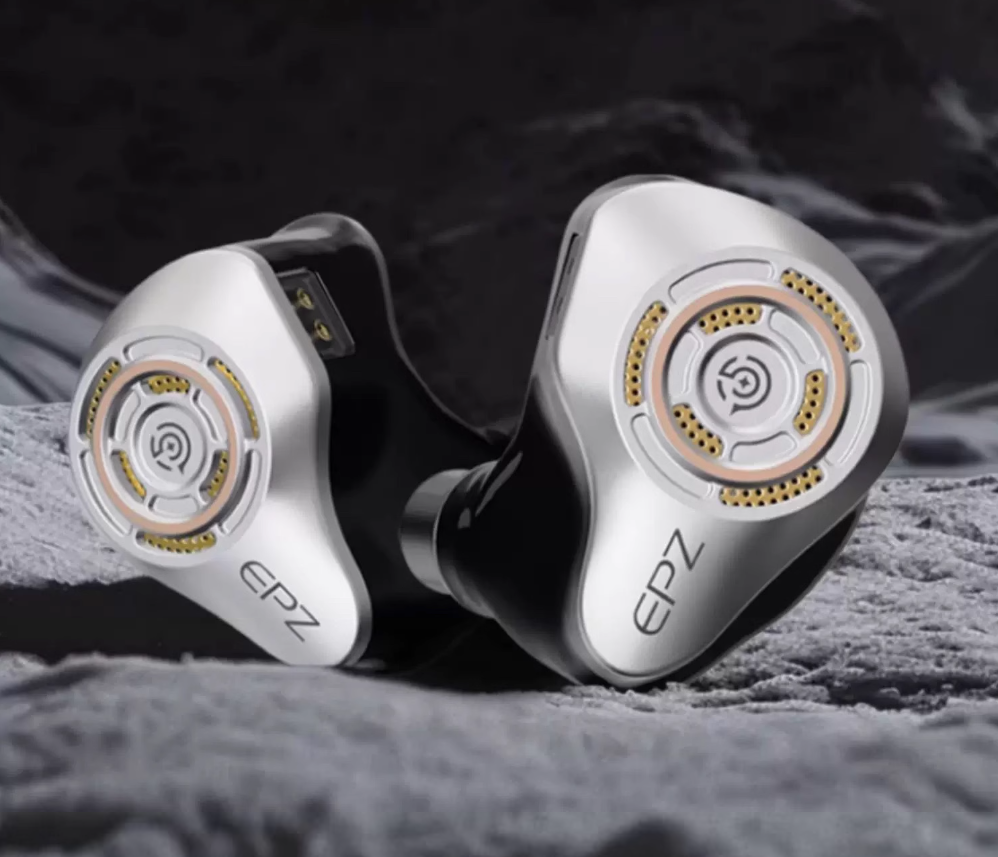
EPZ P50
Unboxing and Accessories
Opening the box, the EPZ P50 delivers a premium unboxing experience that punches above its weight class. The packaging is sturdy and thoughtfully designed, with textures and graphics that give a sense of care and polish. Inside, you get the IEMs nestled securely in foam, a classy leatherette puck-style case, a modular cable with 3.5mm and 4.4mm terminations, six pairs of silicone eartips, and a branded cleaning cloth.
The cable itself deserves special mention. It’s a silver-plated single crystal copper cable with modular right-angle terminations, and although it’s a bit stiff and has some memory, it’s beautifully constructed with stainless steel fittings. The modular mechanism could be smoother - swapping connectors requires some force and finesse - but overall, it’s a step up from what you typically get at this price.
The round carrying case feels great in hand, with orange stitching that adds a stylish touch. It’s big enough to hold everything, though maybe not the most portable. One letdown? The eartips. While functional, they’re the standard wide-bore silicones and don’t reflect the same level of quality as the rest of the package. EPZ actually makes better tips, so I wish they had included those here.
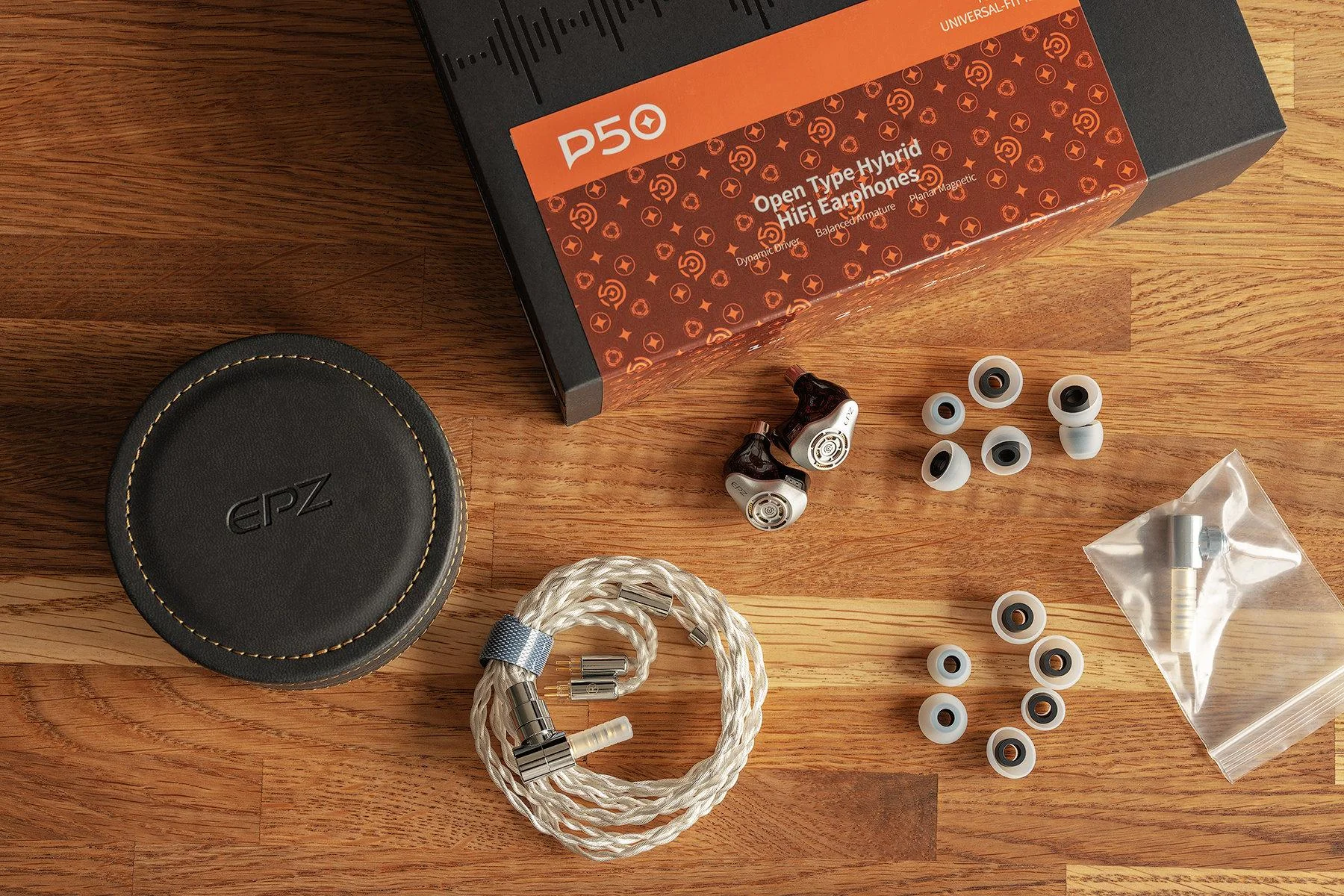
EPZ P50 accessories
Build Quality & Design
In terms of build, the P50 walks the line between lightweight and robust. The main shell is made from 3D-printed medical-grade resin, while the faceplates are milled from 7-series aviation aluminum. The finish is modern and cyberpunk-inspired, with circular vent designs and golden mesh underlays giving it a futuristic flair without being flashy.
Comfort is generally excellent. The shape is semi-custom, with curves and a wing for ergonomic anchoring. That said, the nozzle design is a bit problematic. It’s long and straight with no retaining lip, meaning some tips can slide off during removal - I’ve had a few left behind in my ears. Tip rolling is highly recommended to find the right combination of seal and grip.
The P50 is also semi-open, with true rear vents that contribute to its wide, airy sound. Isolation is decent, but expect some sound leakage. It reminds me more of semi-open headphones than traditional closed-back IEMs.
Sound Impressions
EPZ calls the P50 a “smooth” IEM, and I think that captures its essence well. It’s a tribrid with a 10mm dynamic driver for bass, two balanced armatures for mids, and two micro planar drivers for treble. That’s a lot going on under the hood, but the result is impressively cohesive.
Bass
The bass leans warm and polite. Sub-bass extension is good, but it’s not thunderous or overly tactile. It rumbles when the track calls for it, but this is not a basshead’s IEM. Midbass has decent punch but is a bit soft and rounded. You won’t get the slam of something like a QKZ x HBB Khan here. Still, it’s clean and doesn’t bleed much into the mids.
One quirk: some users (myself included) noticed that the bass feels more controlled and fuller when covering the rear vents. This suggests the tuning interacts with the semi-open design in interesting ways.
Mids
This is where the P50 shines. The midrange is forward, lush, and highly detailed. Vocals - both male and female - come through with clarity and body. There’s a slight upper mid boost that adds presence without becoming shouty or sibilant. Instruments are well-placed and never feel congested, even in busy tracks.
There’s a smoothness here that makes the P50 endlessly listenable. I’ve had sessions that lasted five or six hours without a hint of fatigue. That’s rare, and a sign of well-judged tuning.
Treble
The treble from the dual planar drivers is airy, quick, and crisp. It’s not spiky, nor does it sound overly thin or metallic as some budget planars can. Cymbals have natural decay, and there’s enough sparkle to keep things engaging without going overboard. However, those craving ethereal brilliance or ultra-crystalline highs may find the P50 a bit subdued.
Overall, the treble extends well, offering a sense of openness and air without being harsh. It’s a delicate balance that EPZ mostly nails.
Technicalities
The soundstage is one of the most impressive aspects of the P50. It’s wide, holographic, and enveloping - helped by the semi-open design. Imaging is precise with solid layering. You can easily pick out instruments in complex arrangements, and the separation rivals sets twice the price in my experience.
Detail retrieval is also excellent, with micro-details emerging effortlessly from the mix. Timbre isn’t 100% natural, especially for acoustic instruments, but it’s far from off-putting. It sits in that zone where the sound feels clean and technical without being sterile.
Comparisons
vs. Thieaudio Hype 2: The Hype 2 is punchier and more vibrant, with more bass energy and excitement. However, the P50 feels more cohesive and less fatiguing over long listening. The Hype 2 has an engaging V-shape feel, while the P50 provides a more natural and balanced presentation.
vs. Letshuoer S12: The S12 has more bass slam and brighter, more energetic treble thanks to its full-range planar driver. It’s more aggressive but also more fatiguing. The P50 trades some of that excitement for balance and comfort. Mids are more natural on the P50.
vs. Simgot EA500LM: The EA500LM offers a cleaner and brighter tuning with sharper treble extension and excellent clarity. It’s more energetic and analytical. The P50 leans smoother, more relaxed, and has better layering and staging.
vs. EPZ Q5 Pro: The Q5 Pro is warmer and bassier with a more colored midrange. P50 feels like a more mature, cleaner evolution in tuning. If you liked the Q5 Pro but found it a bit thick, the P50 is a natural upgrade.
Who Should Buy the P50?
The EPZ P50 is a great pick for listeners who value balanced, mid-forward sound with a spacious presentation. It excels with vocals, jazz, acoustic, indie, and pop. If you’re a fan of smooth tonality, subtle technical refinement, and want something fatigue-free, the P50 delivers.
That said, it’s not for everyone. Bassheads will find it too restrained, and treble enthusiasts may crave more shimmer. Also, those sensitive to upper mids might find the occasional glare depending on source pairing.
It also helps if you enjoy experimenting with tips and sources. The P50 can be source-picky - pairing it with a clean, neutral or slightly warm DAC/amp brings out its best. I had fantastic results with the Shanling M6 Ultra and iBasso DX240.
Final Thoughts
The EPZ P50 doesn’t try to wow with bombastic tuning or gimmicky design. Instead, it aims for balance, coherence, and a kind of understated elegance. And in that regard, it succeeds admirably. With a unique tribrid setup and surprisingly cohesive tuning, it’s easily one of the best IEMs I’ve heard under $200.
It won’t be the set I reach for when I want earth-shaking bass or highlighted brilliance - but when I just want to relax and enjoy the music in a wide, immersive space, the P50 is near the top of my list.
If you’re looking for a refined daily driver with just enough technical chops to keep you engaged, the P50 is a worthy addition to your collection. EPZ has done it again.
Where to Buy
You can find the EPZ P50 on:
Affiliate Disclaimer: Listen Vibes may earn commissions from qualifying purchases that helps to maintain the website - at no extra cost to you.