Planar magnetic IEMs have reached the point where technical ability alone is no longer enough to stand out. Fast transients, sharp detail retrieval, and impressive separation are now expected, especially from a brand like Letshuoer that has spent years refining the formula. The Letshuoer Astralis takes a different path. Instead of chasing the brightest or most analytical interpretation of planar sound, it leans toward warmth, weight, and long-term listenability.

Letshuoer Astralis
At around the $189 mark, the Astralis enters a crowded category filled with aggressive tunings and highly resolving competitors, including several models from Letshuoer itself. What immediately makes it interesting is the new 15.5 mm 5th-generation proprietary ring-type planar driver. That alone suggests Letshuoer wanted to move beyond the typical planar presentation and experiment with something that behaves a little more like a dynamic driver while still retaining planar speed.
To my ears, the Astralis succeeds most when it focuses on musicality rather than outright technical fireworks. The bass hits with authority, the treble avoids the sharp glare that some planar sets struggle with, and the overall tuning feels intentionally smoother and darker than the usual planar crowd. At the same time, it is not a universally safe tuning. The midrange can sound slightly boxy depending on the track, and listeners who want maximum openness or sparkle may find the presentation too restrained.
Unboxing and First Impressions
The unboxing experience is familiar if you have seen other recent Letshuoer releases. The presentation is clean and organized rather than luxurious, with the packaging style closely resembling some of the company’s more affordable models. That may disappoint buyers expecting a flagship-style reveal, especially considering the increasingly competitive market around this price point.
Opening the box keeps things straightforward. The earpieces and carrying case immediately take center stage, and the included accessories are practical without feeling excessive. Letshuoer includes two sets of silicone tips, a modular cable, and one surprisingly useful addition: a 3.5 mm dongle. That dongle helps the Astralis feel more approachable for casual use straight from a phone or laptop, and it is still uncommon enough in the IEM space to stand out.
The modular cable is another highlight. It feels durable, easy to handle, and avoids the stiff or overly heavy feel that can make aftermarket-style stock cables annoying in daily use. The carrying case also does its job well without adding unnecessary bulk.
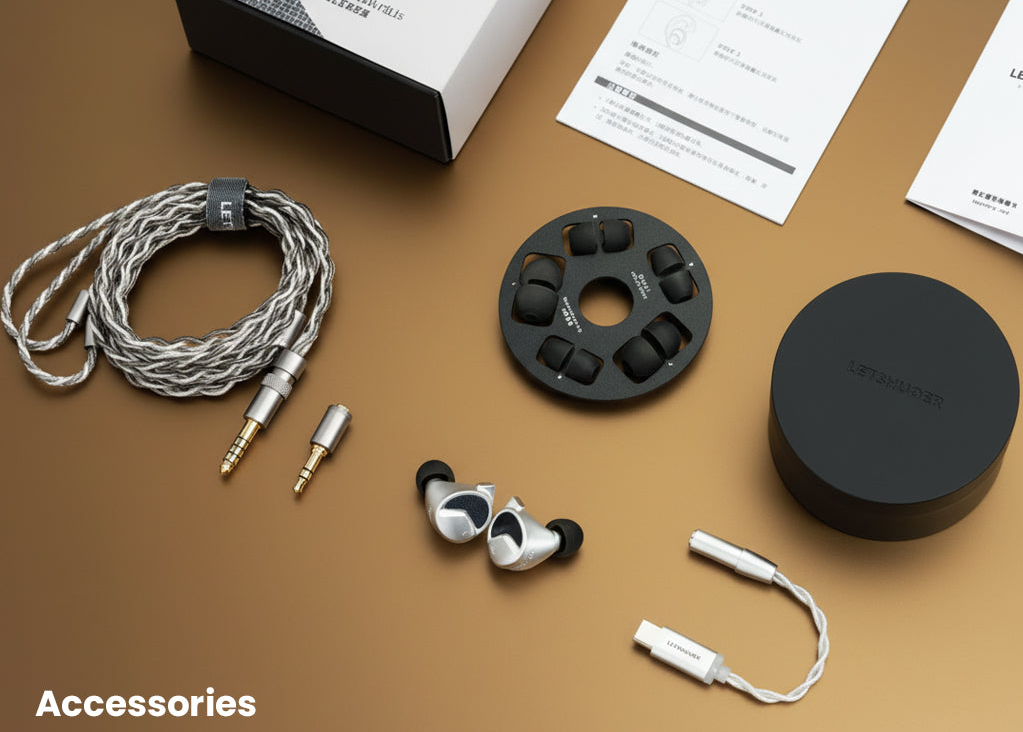
Letshuoer Astralis Accessories
Build Quality and Design
The Astralis makes a strong first impression with its understated industrial styling. Instead of flashy resin shells or oversized faceplates, Letshuoer went with a more discreet aluminum alloy construction finished in silver. The result looks clean, modern, and mature without trying too hard to attract attention.
The aluminum shells give the Astralis a reassuringly solid feel while keeping the weight under control. I especially like that Letshuoer avoided making the shells unnecessarily bulky despite the large 15.5 mm planar driver inside. Compared to some earlier planar IEM designs that felt oversized or awkward, the Astralis looks noticeably more refined.
Comfort seems to depend slightly on ear shape. The shells are relatively small for a planar model, and many listeners will probably find them easy to wear for long sessions. At the same time, the shape is not perfectly ergonomic, so the fit may not lock in as naturally as some molded resin competitors. To my eyes, though, the design strikes a good balance between compactness and stability.
The modular cable deserves another mention here because it complements the overall premium feel well. It avoids microphonics effectively and does not fight against the ear hooks during use. Combined with the lightweight shells, the Astralis feels easy to live with in everyday listening.
Sound Quality
The Astralis delivers a warm-leaning planar sound with a mild W-shaped character. Instead of overwhelming the listener with upper-mid energy or hyper-etched detail, it focuses on bass authority, smooth treble control, and an easygoing overall balance. I found it more relaxed than many competing planar sets, though not necessarily less engaging.
The tuning can feel slightly contradictory at times. Some tracks make it sound dark and smooth, while others reveal flashes of upper-end zing and air. That unusual combination gives the Astralis personality, even if it occasionally creates inconsistencies depending on genre and recording quality.
Bass
Bass is one of the Astralis’ strongest traits. The low end is elevated, full-bodied, and impressively controlled for a planar driver. Instead of the leaner or drier bass response often associated with planar IEMs, the Astralis pushes more weight and slam into the presentation.
Sub-bass reaches deep with satisfying rumble, and electronic music benefits especially well from the added authority. Kick drums hit with convincing impact while remaining fast enough to avoid becoming muddy. I also noticed that bass guitars retain excellent speed and articulation, which helps preserve the typical planar sense of precision.
Not everyone will agree on the bass quality, though. Some listeners may still prefer the more physical decay and natural resonance of stronger dynamic-driver implementations or even some competing planars like the S15. To my ears, the Astralis balances impact and control effectively, but it still carries a slightly planar-style texture rather than fully mimicking dynamic-driver warmth.
Midrange
The midrange is where opinions are likely to split the most. Vocals generally sound smooth, warm, and controlled, with enough detail retrieval to keep singers expressive and intelligible. Male vocals especially benefit from the fuller lower-mid presence.
At the same time, there are moments where the mids can feel boxed in or slightly closed off. Certain recordings expose a mild congestion in the center image, and vocal placement can occasionally seem more distant than expected. Listeners coming from brighter or more open-sounding planars may immediately notice that reduced sense of air.
I would not call the midrange recessed overall, but it is definitely more relaxed and less aggressively forward than many competitors. That tuning choice makes the Astralis easier to listen to for extended sessions, especially with modern pop or compressed recordings that become fatiguing on brighter sets.
Instrument timbre is another interesting aspect. The Astralis does not completely escape the familiar planar timbre character, particularly in the mids, but it handles it better than some earlier implementations. Acoustic instruments still carry a slightly processed texture at times, though the warmer tuning helps smooth over the sharper edges.
Treble
Treble is smoother and calmer than what many listeners expect from a planar magnetic IEM. The Astralis avoids harshness extremely well, and I rarely get the sense that cymbals or strings are trying to force detail into the foreground.
There is enough energy to maintain clarity, but the emphasis feels carefully controlled. In fact, the Astralis creates an unusual impression where the lower treble can sound dark while the upper treble still introduces moments of air and sparkle. That duality is part of why some people may describe it as both warm and slightly zingy.
The upside is excellent long-term comfort. Sibilance stays under control, aggressive recordings become easier to tolerate, and treble-sensitive listeners will probably appreciate the smoother approach. The downside is that some listeners may want more openness, extension, and excitement in the upper registers.
Compared to brighter planar sets, the Astralis prioritizes refinement over attack. I think that decision works well for relaxed listening but makes the presentation feel less immediately impressive during quick comparisons.
Technical Performance
Technical performance is strong overall, though not class-leading for the planar category. Detail retrieval remains comfortably above average compared to many hybrid or dynamic-driver IEMs near this price, but the Astralis does not constantly push microdetail to the front of the mix.
Separation and layering are handled confidently, especially during busy passages where the planar driver speed becomes obvious. Fast rock tracks, electronic arrangements, and dense instrumental sections remain organized without collapsing into blur.
Imaging performance is solid but not razor sharp. Some listeners may find competing models like the Zetian Wu more precise in directional placement. Soundstage is another divisive area. I hear decent width and some holographic qualities, but the stage does not feel especially massive, and the slightly closed-in midrange can reduce the sense of openness.
What I appreciate most is that the Astralis rarely sounds strained. Even when tracks become busy, the presentation stays composed and controlled. It may not be the most analytical planar IEM available, but it delivers a satisfying balance between technical competence and musical comfort.
How It Compares
The Astralis enters direct competition not only with the broader planar market but also with Letshuoer’s own lineup. That makes its tuning decisions particularly important.
Against models like the S12 Ultra or MP145, the Astralis feels less aggressively technical. Those sets often push detail and upper-end energy harder, creating a more immediately impressive presentation. The Astralis instead leans into comfort and balance, making it easier to enjoy for long sessions without fatigue.
The Letshuoer S15 remains an interesting comparison because some listeners may still prefer its bass quality and resonance characteristics. The Astralis delivers strong bass control and speed, but the S15 can feel slightly more physical and textured in the low end.
What ultimately separates the Astralis is its identity. Many planar IEMs chase maximum clarity and sparkle, while the Astralis sounds intentionally smoother and more grounded. That makes it less of a showcase product and more of a daily-listening option for people who enjoy planar speed without the usual brightness overload.
Is It Right for You?
The Astralis makes the most sense for listeners who enjoy planar detail and speed but want a warmer, smoother tuning than usual. If brighter planar sets leave you fatigued after an hour, the Astralis offers a more relaxed alternative without abandoning technical capability entirely.
I think it pairs especially well with electronic music, modern pop, rock, and instrumental tracks that benefit from strong bass control and clean separation. The elevated low end gives drums and synth lines satisfying impact, while the smoother treble helps prevent sharp recordings from becoming tiring.
Treble-sensitive listeners are likely to appreciate the restrained upper-end approach. Even when the Astralis introduces moments of sparkle, it rarely crosses into harshness or sibilance.
On the other hand, listeners who prioritize maximum openness, huge soundstage dimensions, or highly forward vocals may prefer something brighter and more analytical. The slightly boxy midrange character will also bother some people more than others.
The Astralis is not really a reference-monitor type of IEM. It is better suited for listeners who value musical enjoyment and long-session comfort over ultra-clinical precision. If that sounds appealing, the tuning approach becomes much easier to appreciate.
Final Verdict
The Letshuoer Astralis succeeds by refusing to follow the safest path for a modern planar IEM. Instead of leaning fully into brightness and hyper-detail, it delivers a warmer, smoother, bassier interpretation of planar sound that feels designed for real-world listening rather than quick showroom impressions.
Its strongest qualities are the controlled and powerful bass response, fatigue-free treble tuning, solid technical ability, and excellent metal construction. The new ring-type planar driver gives the Astralis a more physical and grounded presentation than many planar competitors, even if it still carries traces of traditional planar timbre.
The tradeoffs are clear. The midrange can sound slightly boxy, the soundstage is not especially expansive, and listeners who want maximum sparkle or vocal openness may find the tuning too restrained. Opinions will definitely differ depending on personal preference and comparison points.
Still, I think the Astralis earns its place in Letshuoer’s lineup because it offers something genuinely different. It is a comfortable, mature, and musically satisfying planar IEM that prioritizes long-term enjoyment over exaggerated technical flash. For listeners looking for a warmer planar experience with strong bass authority and polished build quality, the Astralis is easy to recommend.
Where to Buy
You can find the Letshuoer Astralis on:
Affiliate Disclaimer: Listen Vibes may earn commissions from qualifying purchases that helps to maintain the website - at no extra cost to you.