There is no shortage of planar IEMs under $200, which makes the Roseselsa x AAV CJ20 stand out for how focused it feels. Instead of chasing a soft, all rounder tuning, it leans into speed, clarity, and structure, aiming for a more energetic and controlled presentation that fits well with busy, rhythm driven music.
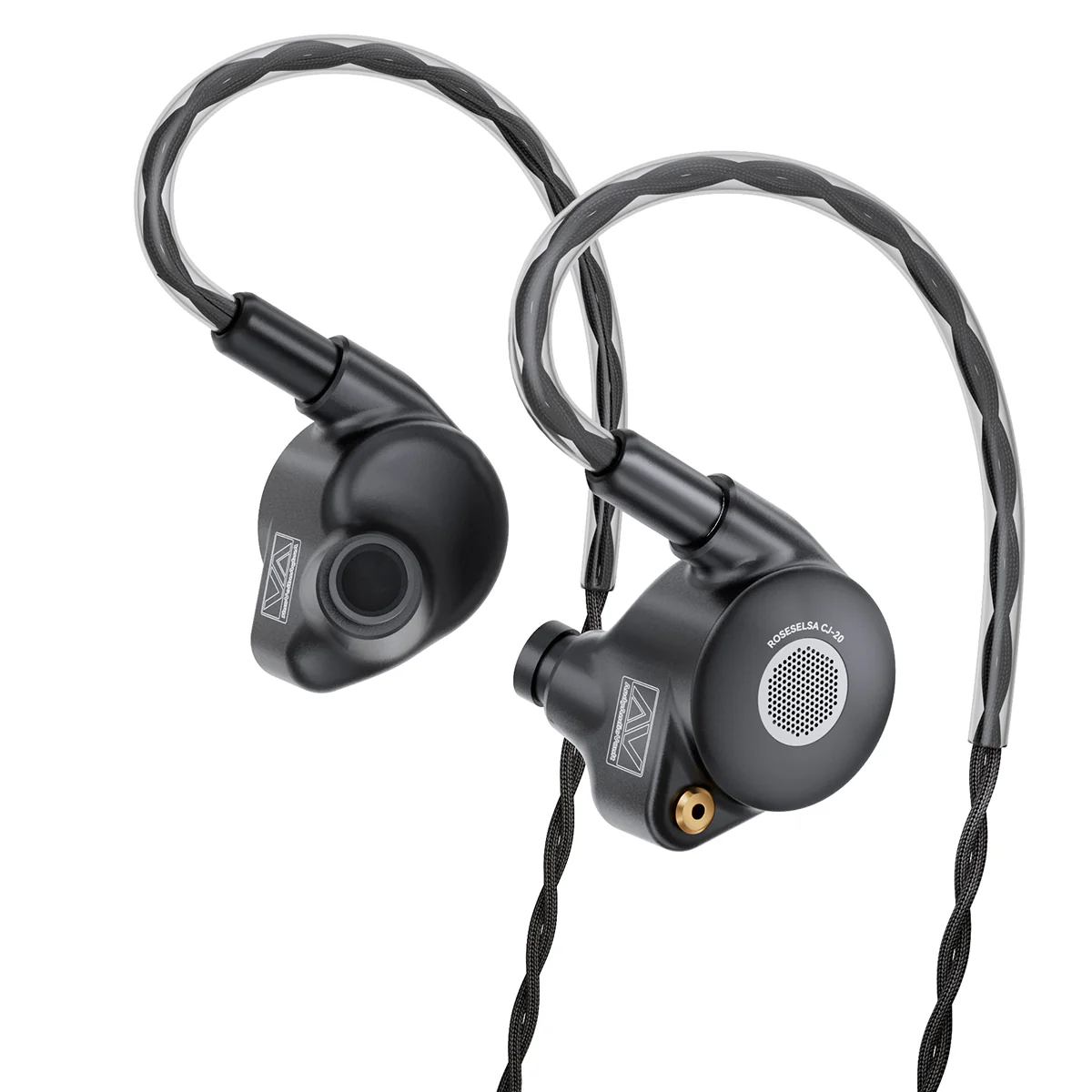
Roseselsa x AAV CJ20
At around $169, this is a planar designed for listeners who want punch, separation, and momentum rather than sheer warmth or weight. It makes a few clear tradeoffs along the way, especially in sub bass depth and midrange body, but that sense of direction is exactly what gives the CJ20 its identity.
Unboxing and First Impressions
The unboxing experience strikes a good balance between simplicity and personality. The packaging is compact and practical, with just enough visual flair to feel like an enthusiast product without trying to present itself as a luxury item.
Inside, everything is neatly organized. The IEMs are secured properly, and the accessories are separated into their own compartment rather than being loosely packed. It gives the impression of a product designed for regular use rather than just presentation.
Accessories are a strong point overall. Multiple ear tips are included with different bore styles, and the modular cable comes with both 3.5 mm and 4.4 mm plugs, which adds real flexibility. The only downside is that the cable, while versatile, can be prone to tangling, so it may not feel as refined in daily use as its feature set suggests.
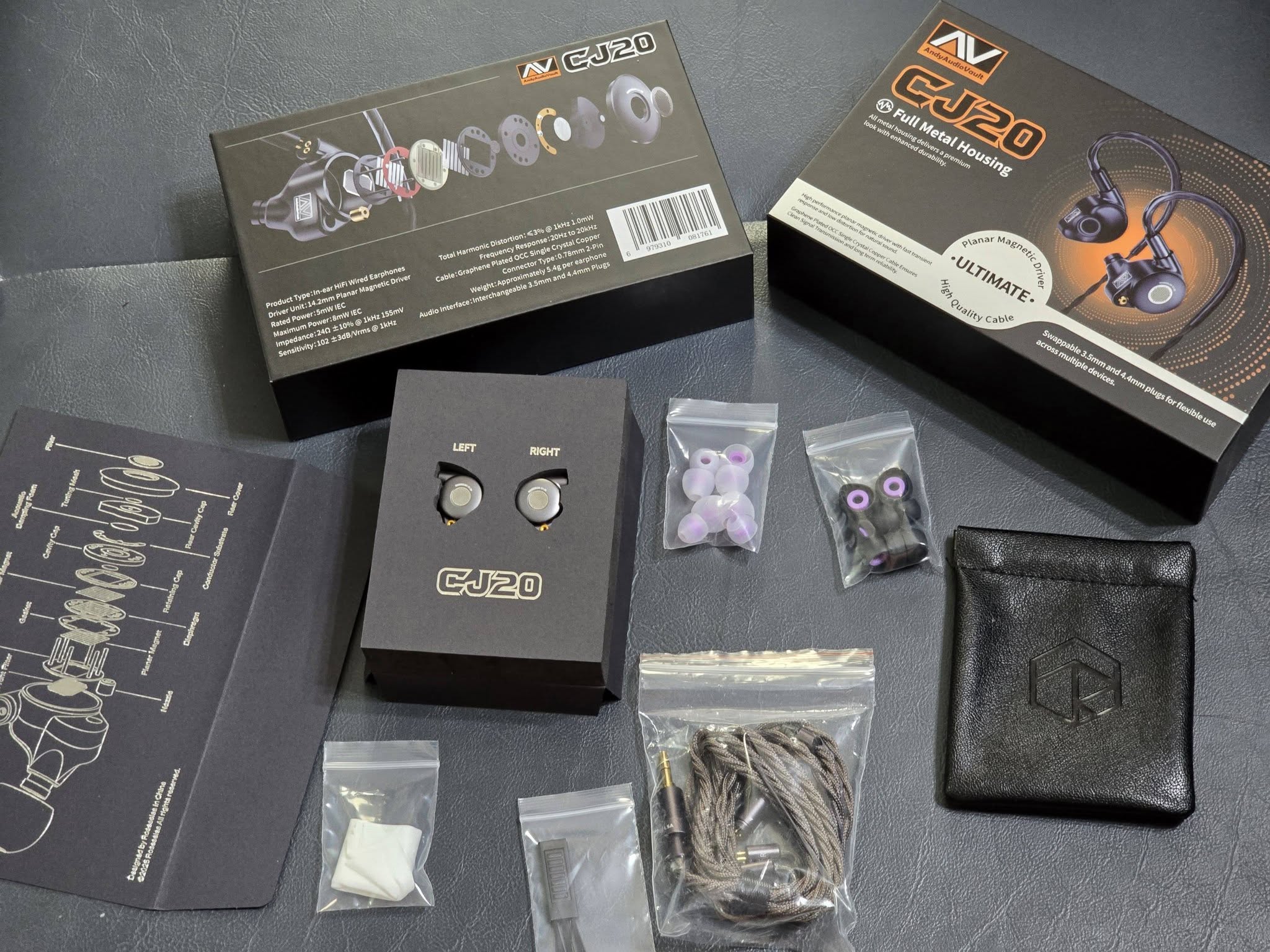
Roseselsa x AAV CJ20 Accessories
Build Quality and Design
The CJ20 makes a solid impression with its all metal housing. The finish looks clean and precise, giving it a more premium feel than many competitors in this price range. It comes across as well constructed without trying to be flashy.
The design itself is fairly restrained, which I see as a positive. It avoids overstyled elements and instead focuses on a shape that feels purposeful and easy to wear. There is enough character in the overall look to avoid feeling generic, but the emphasis is clearly on usability.
Comfort seems good for most cases, with a snug and ergonomic fit, though it may not be perfectly consistent for everyone. Seal sensitivity can vary depending on ear shape, so tip selection becomes important. The modular cable adds convenience, but its tendency to tangle slightly detracts from the otherwise strong build experience.
Sound Quality
The big picture with the CJ20 is fairly clear to me. This is a fast, energetic planar with a safe but still lively V shaped tuning, a clean overall presentation, and a tonal balance that seems especially comfortable with rock, metal, and other rhythm driven genres. It does not sound like a basshead planar or a lush vocal specialist. Instead, it seems built around attack, separation, and control.
Bass
The bass sounds punchy rather than huge. That distinction matters. The CJ20 appears to deliver bass notes with quick start and stop behavior, which is one of the usual strengths people want from planar drivers in the first place. Kick drums seem to hit with conviction, and bass lines are described more as tidy and controlled than thick and room shaking.
Where I would temper expectations is in the lowest octave. Sub bass rumble seems to be one of the more consistent weak points mentioned around this set. So while the CJ20 should keep rhythm sections sounding tight and energetic, I would not go into it expecting a deep, heavy foundation that floods the mix with physical weight. For metal, hard rock, and faster music, that trade can work well. For electronic genres that rely on sustained low end pressure, it may feel a bit restrained.
Midrange
The midrange is one of the more debated parts of the CJ20, and I think that is because it sits at an interesting intersection between clarity and body. To my ears, the overall picture suggests a cleaner, slightly leaner midrange that favors separation and crisp articulation over warmth. That can be a real strength when mixes get crowded. Guitars, snare hits, and vocal lines are less likely to smear together, and the CJ20 seems tuned to preserve that sense of structure.
At the same time, this is not a universally romantic or full bodied midrange. Some impressions lean toward a richer, more substantial center image, while others hear vocals as slightly recessed or a bit boosted in a way that changes their natural weight. That tells me the CJ20 probably walks a fine line. It can sound engaging and clear, but listeners who prefer denser note body and more natural warmth may not fully buy into its presentation.
Treble
Treble is another area where balance matters, and the CJ20 seems to handle it with more restraint than some planar rivals. There is clear extension and enough upper end energy to support its fast, vivid character, but it does not appear to rely on sharp peaks to fake detail. That is important because planar IEMs can easily cross from exciting into fatiguing when the treble is pushed too hard.
Here, the general impression I get is of a clean, extended top end that stays mostly controlled. Opinions differ mainly in emphasis rather than direction. Some hear the treble as strongly present and lively, while others focus more on the fact that it stays smooth enough for longer sessions. Those two takes can both be true. The CJ20 likely has enough bite to sound crisp and alert, but not so much that it turns every cymbal strike into a problem.
Technical Performance
Technical performance is one of the CJ20’s main selling points, and it seems to justify that reputation to a meaningful degree. Speed, transient response, and separation appear to be real strengths. Complex passages are said to stay organized, imaging is described as precise, and the set seems good at tracking directional cues in a mix. That all fits the intended use case very well.
Where I would be careful is in calling it elite. I do not get the sense that the CJ20 is weak technically. Far from it. I hear it as a strong technical performer for the price, especially if the goal is clarity and composure in busy arrangements. But opinions differ on just how far that advantage goes, and there are hints that some competitors in the planar space still pull ahead in absolute detail retrieval.
So my final read is this: the CJ20 sounds technically accomplished, clearly above average in control and precision, but not untouchable. It is a very capable planar, not an automatic category champion.
How It Compares
The most useful comparison here is the Hidizs MP145, because it helps define exactly where the CJ20 sits. Against the MP145, the CJ20 appears to trade some warmth and bass body for greater speed, a cleaner midrange line, and more pinpoint imaging. The MP145 sounds like the more forgiving and fuller option, while the CJ20 comes across as the tighter and more incisive one.
That difference tells me a lot about the CJ20’s personality. If I wanted a planar that smooths things over a bit more and adds extra low end cushion, I would probably lean toward the MP145 style of presentation. If I wanted faster transients, a cleaner sense of separation, and a more focused stage, the CJ20 sounds like the sharper tool.
There are also broader hints about where it lands among other popular planars. The CJ20 seems competitive with solid mid tier options and does enough technically that it should not be dismissed in this segment. At the same time, I do not come away thinking it sweeps the field. In pure detail retrieval and top of class status, it sounds like there are alternatives that still edge it out.
That is why I see the CJ20 less as a universal recommendation and more as a targeted one. It is not merely trying to be another planar in the pile. It is a planar for listeners who value speed, precision, and a cleaner cut through dense music, even if that means giving up some fullness and some last ounce of low end weight.
Is It Right for You?
The CJ20 is best suited for listeners who prioritize speed, clarity, and separation. If your music leans toward rock, metal, or any fast paced genre with dense layering, this tuning plays directly to those strengths and keeps everything organized without losing energy.
It is less ideal for those looking for deep sub bass rumble, lush mids, or a forgiving signature. If you prefer warmth and weight over precision, or want something more relaxed for casual listening, this may not be the best match.
Final Verdict
The Roseselsa x AAV CJ20 stands out by having a clear identity. It focuses on speed, punch, and control, and that gives it a distinct place in the sub-$200 planar market.
It is not perfect. Sub bass is limited, the midrange may feel lean for some, and while the technical performance is strong, it does not completely dominate the competition. Even so, it remains a compelling option for listeners who want a clean, energetic, and rock friendly planar without unnecessary softness.
Where to Buy
You can find the Roseselsa x AAV CJ20 on:
Affiliate Disclaimer: Listen Vibes may earn commissions from qualifying purchases that helps to maintain the website - at no extra cost to you.