Flat-head earbuds occupy an unusual space in today’s portable-audio market. They give up the seal, isolation, and deep sub-bass response of an IEM, but in return they can deliver a wonderfully open presentation without inserting anything into the ear canal. The Sivga M260 makes a convincing case that this older format still has plenty to offer. At $39.99 for the standard 3.5mm version, or $45 for the USB-C version with its own DAC, inline controls, and microphone, it brings unusually serious construction and features to the category.
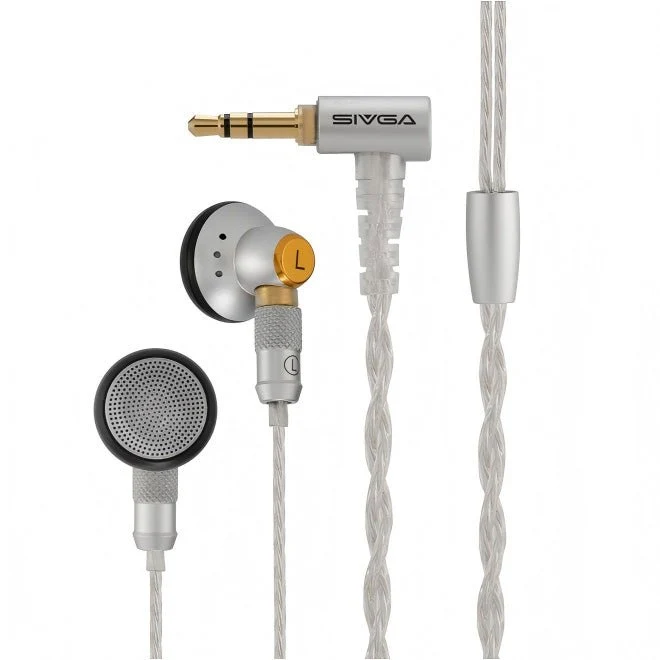
Sivga M260
What immediately interests me about the M260 is that it does not try to disguise what it is. This is not an earbud tuned to imitate a bass-heavy sealed IEM. Its character is cleaner, lighter, and more spacious, with the midrange taking center stage and the bass naturally losing authority as it reaches into the lowest frequencies. That approach works particularly well for voices, acoustic instruments, podcasts, and music where clarity matters more than physical low-end impact.
The hardware also helps distinguish it from inexpensive nostalgic earbuds. Machined metal shells, detachable MMCX connections, a 14.2mm dynamic driver, multiple foam options, and a proper carrying case make the M260 feel unusually complete for the price. Its weaknesses are equally clear: there is essentially no isolation, fit depends heavily on ear shape, and bass-focused listeners will probably want something else. Within those boundaries, though, the M260 is a thoughtful and appealing interpretation of the flat-head earbud.
Unboxing and First Impressions
The M260 comes in a compact black box, and the presentation is straightforward but more complete than I would expect at this price. Inside is an Oxford-fabric carrying case holding the earbuds and cable, accompanied by the manual and spare foam covers. It feels like a complete package rather than a product where the accessories have been stripped back to hit a low price.
Two different foam styles are included: conventional full-coverage foams and donut-style foams with the center exposed. They are more than cosmetic accessories because they provide a small degree of tuning control. I prefer thinking of them as the M260’s equivalent of tip rolling on an IEM. The full foams soften the presentation slightly, while the donut foams allow a little more openness and upper-frequency energy.
The cable depends on the version purchased. The standard model uses a 3.5mm connection, while the $45 USB-C version includes a cable with an integrated DAC, microphone, and three-button remote. Volume controls and play/pause are available directly from the cable, with track skipping handled through a double press. For phone, tablet, or laptop use, that makes the USB-C version particularly convenient because no separate dongle is required. Both versions benefit from detachable MMCX connections at the earbuds, giving the M260 more long-term flexibility than most inexpensive flat-head designs.
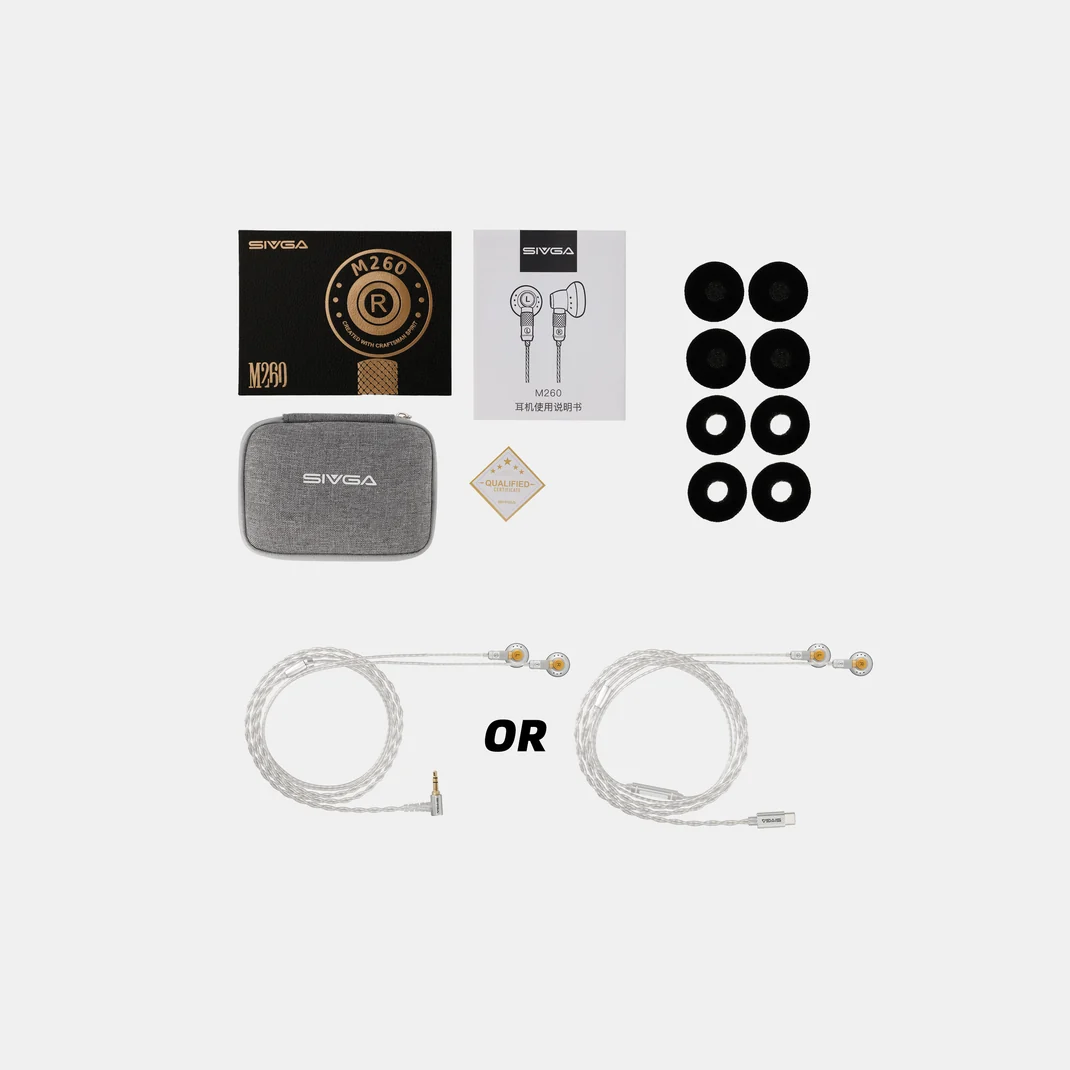
Sivga M260 Accessories
Build Quality and Design
The construction is one of the M260’s strongest selling points. Instead of the molded plastic shells I associate with many inexpensive flat-head earbuds, Sivga uses machined metal housings with a knurled cylindrical section behind the driver. The design looks simple, functional, and considerably more substantial than the price suggests.
Under the removable foam sits a metal grille covering a 14.2mm dynamic driver. The driver uses a composite bio-cellulose diaphragm with copper-ring reinforcement, a CCAW voice coil, and N50 neodymium magnets. Those details would be respectable in a more expensive product and reinforce the impression that Sivga has taken the format seriously rather than treating the M260 as a novelty.
The shells are semi-open, with ventilation behind the driver. That architecture is fundamental to both the strengths and weaknesses of the M260. It contributes to the airy presentation and sense of openness, but it also means isolation is effectively nonexistent. I would not choose these for a flight, a noisy commute, or anywhere that requires blocking external sound. They make far more sense at a desk, around the house, or in another reasonably quiet environment where hearing the room is actually desirable.
Comfort is potentially excellent because nothing enters the ear canal, avoiding the pressure and insertion fatigue associated with some IEMs. The metal shells are also light enough that the construction never feels excessively heavy. Fit, however, is far less adjustable than with an IEM. There are no different tip sizes to compensate for individual anatomy: the housing either sits naturally in the outer ear or it does not. The M260 is also relatively large, so smaller ears may struggle with the shape. Wearing the cable over the ear can improve stability, and the light cable is well suited to that arrangement.
I also like the detachable MMCX system at this price. It allows a damaged cable to be replaced and gives the choice between conventional analog and other compatible cable options. As usual with MMCX, I would grip the connector housings rather than pulling directly on the wires when changing cables.
Sound Quality
The M260 has a clean, open, slightly relaxed presentation that leans closer to neutral than warm or aggressively entertaining. Its greatest strengths are the midrange, vocal reproduction, and the spacious character created by the open flat-head design. I hear it as a clarity-first earbud rather than one built around bass impact.
Bass
Bass is controlled and respectable for the format, but physics ultimately sets the limit. Without a proper acoustic seal, the M260 cannot generate the deep pressure and extension that a sealed IEM can. Sub-bass rolls away clearly, so very low electronic notes lose physical weight and rumble. I would not recommend the M260 to anyone whose priorities are powerful sub-bass, heavy electronic music, or visceral low-end impact.
Importantly, the lack of deep extension does not make the overall balance sound empty. Mid-bass remains present enough to provide body, and Sivga avoids compensating for the missing sub-bass with an exaggerated upper-bass hump. I prefer that decision because it keeps the presentation clean and prevents bass from spilling over the midrange. The result is leaner than a typical fun-tuned IEM but coherent within the limitations of an open earbud.
Midrange
The midrange is where the M260 makes its strongest impression on me. Vocals sit clearly toward the front without becoming excessively shouty, and acoustic instruments have a transparent, articulate quality. Male vocals retain natural body despite the generally lean tonal balance, while strings and guitars benefit from the sense of air around individual notes.
This is the region that makes me most interested in the M260 for vocal-centered music and spoken content. Voices remain easy to follow, and there is enough warmth to prevent the presentation from becoming sterile. The emphasis is on intelligibility, texture, and separation rather than lush thickness. Anyone coming from a warm or bass-heavy IEM may initially perceive the M260 as light, but the midrange itself is neither hollow nor recessed.
Treble
Treble continues the clarity-focused approach. There is enough energy to give cymbals, strings, and small details definition, but I do not find the overall balance aggressively sharp. Sibilants and hi-hat energy can come through cleanly without forcing the entire signature into an obviously V-shaped or harsh presentation.
The choice of foam also matters here. Full foams slightly calm the upper frequencies, while donut foams expose a little more air and energy. I like having that small amount of control because the physical fit of a flat-head earbud already influences tonal balance more than it would with a consistently sealed IEM.
Technical Performance
The M260’s technical presentation is defined more by openness and layering than by sheer scale. Its semi-open design creates an airy image with good separation, making individual parts of a mix easier to distinguish than I would expect from an inexpensive earbud. Imaging can feel nicely layered, especially with acoustic arrangements and vocal material.
I would not describe it as having an enormous stage in every situation. The more important quality is that the presentation breathes naturally and avoids the closed-in feeling that inexpensive sealed designs sometimes produce. Detail retrieval is also strong enough to complement the transparent midrange without turning the M260 into a clinical listening tool. Distortion remains well controlled through most of the audible band at reasonable levels, supporting the generally clean character of the driver.
How It Compares
The most important comparison is not with another specific earbud but with the modern IEMs available around the same price. A conventional sealed IEM will usually provide deeper bass extension, much stronger isolation, and more control over fit through interchangeable tips. For commuting, public transport, flights, or bass-heavy listening, that format has obvious practical advantages.
The M260 takes the opposite approach. It leaves the ear canal open, allows outside sound to remain audible, and produces a presentation that feels less enclosed. I prefer the M260 when vocals, acoustic instruments, podcasts, or general desk listening are the priority and isolation is unnecessary. It has a lighter, more neutral-leaning tonal balance than the warm or aggressively boosted signatures common among inexpensive IEMs.
The hardware also compares favorably with many budget alternatives. Machined metal housings and detachable MMCX connectors are unusual around the $40 mark, and the USB-C version is especially versatile. Its integrated DAC, microphone, and controls make it easy to connect directly to modern phones or laptops without another adapter.
The foam system provides a limited but useful substitute for the tuning flexibility normally offered by IEM tips. Full foams slightly soften the sound, while donut foams preserve more openness. The difference is not transformative, but it is enough to fine-tune the presentation. Ultimately, choosing the M260 over an IEM is less about absolute technical superiority and more about preferring the comfort, awareness, and open presentation of the flat-head format.
Is It Right for You?
I would choose the M260 primarily for someone who already understands the appeal of a flat-head earbud or wants an inexpensive introduction to the format. It makes particular sense for desk listening, working from home, quiet rooms, and situations where staying aware of the surroundings is useful rather than distracting.
Its sound is best suited to listeners who value vocals, acoustic instruments, clarity, and a relatively neutral balance. Podcasts and spoken content also fit its strengths particularly well because the midrange is forward, intelligible, and natural without requiring excessive volume. Music that benefits from separation and an open sense of space is another good match.
Bass enthusiasts should look elsewhere. The M260 cannot reproduce the deepest frequencies with the authority of a sealed IEM, and anyone expecting strong sub-bass rumble will immediately notice that limitation. It is equally unsuitable for noisy environments because it provides essentially no isolation.
Fit is the other consideration. Anyone who dislikes inserting IEM tips into the ear canal may find this style refreshing, but the shell needs to suit the shape of the outer ear. There is little opportunity to correct a poor fit, and the relatively large housing may be troublesome for smaller ears.
For the right listener, however, the M260 offers an unusually polished combination of sound, materials, and practical features at a very approachable price.
Final Verdict
The Sivga M260 succeeds because it embraces the strengths of the flat-head format instead of trying to imitate a sealed IEM. Its bass does not extend particularly deep, and it offers effectively zero isolation, but those compromises come with an open presentation, excellent midrange clarity, natural vocals, and a comfortable non-invasive design when the shell fits properly.
I am particularly impressed by how much hardware Sivga provides for the money. The machined metal shells, 14.2mm bio-cellulose dynamic driver, detachable MMCX cable, two foam styles, carrying case, and optional USB-C DAC cable make the M260 feel more complete than its sub-$50 price suggests.
I would not choose it for bass-heavy listening, commuting, or anyone who needs dependable isolation. I would choose it for vocal music, acoustic material, podcasts, and relaxed listening at a desk or in a quiet room. At $39.99 for the analog version and $45 for USB-C, it is an appealing way to experience what a well-executed modern flat-head earbud can do.
Where to Buy
You can find the Sivga M260 on:
Affiliate Disclaimer: Listen Vibes may earn commissions from qualifying purchases that helps to maintain the website - at no extra cost to you.