The EPZ P40 is the kind of IEM that makes a strong case for specialization over safe tuning. Its four-driver layout per side is ambitious: a 9 mm DLC dynamic driver handles bass, a 7 mm dual-magnet DLC dynamic driver is dedicated to the mids, a second generation micro-planar takes care of treble, and a multilayer PZT driver extends the upper treble. That configuration sounds impressive on paper, but what matters to me is that the P40 actually has a clear sonic identity.
I hear it as a clean, energetic, detail focused IEM with tight bass, leaner mids, lively treble, and very good separation. It is not built around warmth, heavy low end weight, or a thick, forgiving presentation. Instead, it favors speed, definition, and a sense of precision. That makes it engaging rather than sterile, but it also means the P40 can expose its brighter side when the music already has a lot of upper frequency energy.
What I like most is that EPZ has not turned technical ambition into an overcomplicated sound. The P40 still feels musical and easy to enjoy, with enough bass body to keep things grounded and enough treble energy to make details easy to follow. I would not call it the safest all rounder, but I do think it is one of those models that becomes easy to recommend once you know what kind of listener it is aimed at.
EPZ P40
Unboxing and First Impressions
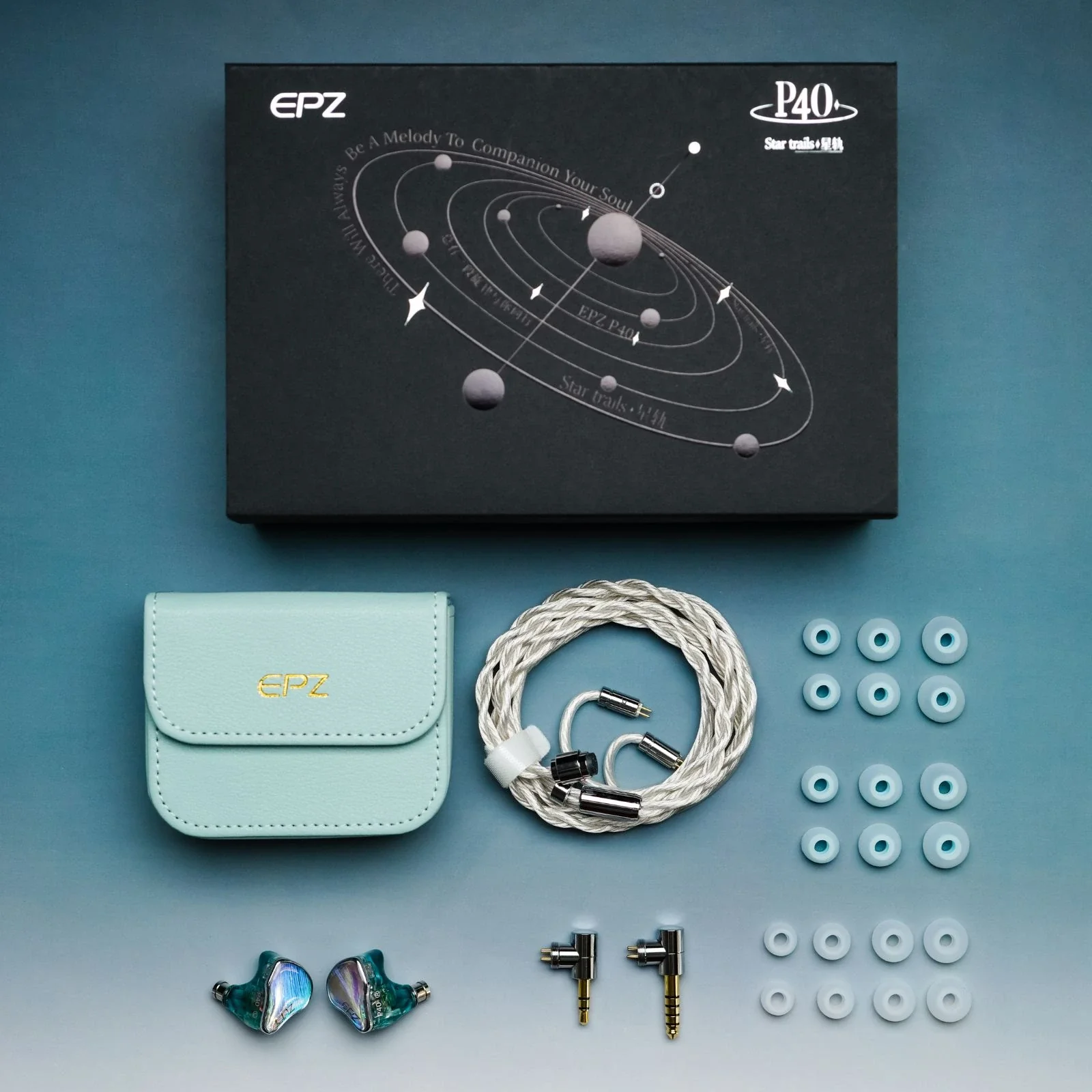
The unboxing experience feels more polished than basic. The P40 arrives in a textured cardboard box, with the earpieces seated in foam next to a light bluish-grey carrying case. The presentation has a premium feel without becoming excessively elaborate, which suits the product well.
EPZ P40 Accessories
The accessory package is one of the stronger parts of the overall offering. EPZ includes a modular silver coated cable with both 3.5 mm and 4.4 mm terminations, so there is no need to replace the cable just to switch between standard single ended and balanced sources. The cable itself has some weight, but it is not so heavy that it should drag noticeably on the shells.
There is also a generous selection of ear tips, including AT07 and M30 options. I like seeing several usable choices included because the P40’s nozzle geometry makes tip choice more important than it is on some shallow fitting IEMs. Taken as a package, the P40 gives a strong first impression: the case is useful, the cable is versatile, and the accessories feel appropriate for an IEM positioned above entry level models rather than like afterthoughts added to fill the box.
Build Quality and Design
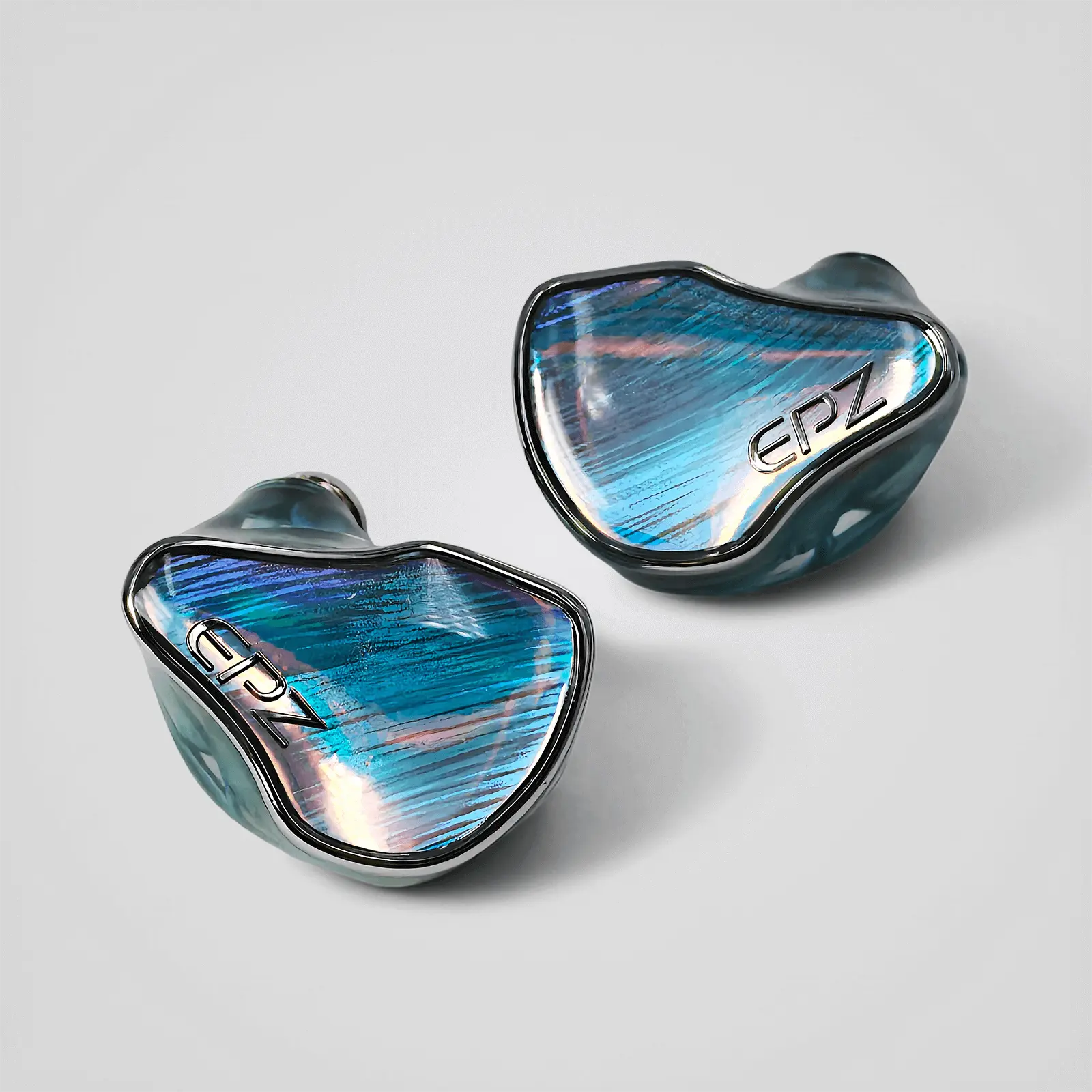
The P40 uses high resolution 3D printed resin shells with a bluish tint and enough transparency to reveal part of the internal construction. I like this design because it gives the earphones a more distinctive identity than another generic opaque shell, while still looking refined rather than flashy.
The shape follows a semi custom approach based on ear data, and the contours are clearly intended to lock into the outer ear rather than simply hang from the nozzle. For me, that is a sensible direction for an IEM with several drivers inside because it helps distribute the shell naturally. The overall form looks carefully considered, and the cable does not appear to undermine that by pulling down on the housings.
Fit is the one part I would treat with some caution. The nozzle is relatively long and inserts deeper than on many relaxed fit designs. Its diameter is not unusually extreme, but the combination of length and insertion depth can make the P40 feel more intrusive if you are sensitive to deeper fits. I would not describe comfort as a weakness in the design itself, because the shell geometry is clearly ergonomic, but ear anatomy and tip choice matter more here than they do with a short nozzle IEM.
Build quality also feels coherent with the rest of the package. Resin shells, a modular cable, a proper carrying case, and a well finished semi custom shape make the P40 feel like a complete product rather than a driver experiment placed inside an ordinary enclosure.
Sound Quality
The P40 has a clean, bright leaning and technical presentation, but it is not clinical to the point of becoming lifeless. Its strongest qualities are control, separation, texture, and clarity. The tonal balance stays engaging because the bass still has enough presence to give music body, while the treble adds air and definition. I would choose it for clarity and precision before I would choose it for warmth or sheer low end impact.
Bass
The bass is handled by a 9 mm DLC dynamic driver, and its character is more controlled than voluminous. I hear good texture, quick response, and a mid bass punch that stays lively without becoming dominant. Bass notes arrive with enough energy to keep the presentation fun, but the P40 does not behave like a basshead IEM.
Sub bass is less imposing. The deepest rumble has a softer, lighter character than on sets tuned for heavy extension and physical pressure. That tradeoff works for me when I want speed and definition, because the low end rarely obscures the rest of the mix. If I wanted maximum depth or a thick foundation, I would look elsewhere.
Midrange
The dedicated 7 mm DLC dynamic driver gives the mids a distinct role in the tuning. The result is natural in tone but somewhat lean in body. Vocals and instruments come through clearly, and the presentation avoids the soft, rounded thickness that can make warmer IEMs sound more relaxed.
I like the clarity, especially when arrangements become busy, but I would still want a little more richness if vocal weight were my top priority. Lower mids do not have a particularly lush or dense character, so the P40 favors articulation over warmth. That makes it a better match for listeners who value clean separation than for anyone chasing a romantic or full bodied midrange.
Treble
Treble is where the P40 shows the most personality. The micro-planar and PZT combination produces an airy, energetic top end with plenty of sparkle and very obvious detail cues. I hear the tuning as bright leaning rather than harsh by default, but there is enough emphasis around the upper treble region that some recordings can become sharp or fatiguing, especially at higher volume.
The advantage is that small details are easy to follow, transients feel crisp, and the presentation never sounds dull. The disadvantage is that the P40 is not especially forgiving. I prefer keeping volume sensible with this kind of tuning, because pushing it harder does not add much musical weight; it mainly makes the treble more assertive.
Technical Performance
Separation is one of the P40’s biggest strengths. Individual instruments are easy to distinguish, and the background feels clean enough that layered passages do not collapse into congestion. Imaging is precise and useful for locating elements across the stereo field, even if I would not call it exceptional.
The stage itself is not especially wide or expansive, so the P40 creates organization more through separation and positioning than through a huge sense of space. Resolution is strong for fine surface detail and note outlines, but I would stop short of calling it class leading for the very smallest inner textures. Overall, its technical performance feels focused and convincing: clean, fast, controlled, and easy to read without pretending to be more spacious than it is.
How It Compares
The most relevant comparison is the EPZ P50 because the two models share a family identity but place treble energy differently. I would choose the P40 over the P50 if I wanted a brighter presentation that feels airier rather than more forward through the lower treble and presence region. The P40 can still become sharp, but its emphasis higher up is easier for me to accept than a more aggressive 3-5 kHz focus.
Against warmer, fuller all rounders, the P40 trades some richness for speed and definition. Bass is tighter rather than bigger, the midrange is cleaner rather than thicker, and the treble is more energetic rather than relaxed. That makes the P40 sound more specialized. It is better suited to listeners who actively want separation, clarity, and a more analytical edge without completely giving up musicality.
I would not pick it solely for soundstage size, nor would I choose it if deep sub bass pressure were the main objective. Its advantage is balance within a technical style: bass remains controlled, mids stay intelligible, and the top end contributes detail without turning the whole presentation into a sterile exercise.
Is It Right for You?
The P40 makes the most sense for listeners who prioritize clarity, speed, separation, and a lively treble response. If you enjoy hearing clean edges around instruments and want complex passages to remain organized, its tuning fits that goal well. It is also a good match for people who prefer tight, textured bass over thick or dominant low frequencies.
I would be more cautious if you are treble sensitive, regularly listen at high volume, or strongly prefer warm and dense mids. The P40 can sound lean, and its upper frequency energy can become tiring when the recording is already bright. Likewise, listeners who want a very wide, cinematic stage may find the spatial presentation more precise than expansive.
Fit should also be part of the decision. The semi custom resin shell is thoughtfully shaped, but the longer nozzle means deeper insertion than some IEMs. If you normally dislike that style of fit, this is worth considering.
For my preferences, the P40 is easiest to recommend as a technical yet still enjoyable IEM rather than a universal crowd pleaser. It rewards listeners who actively want its strengths instead of trying to hide its character.
Final Verdict
The EPZ P40 succeeds because it has a clear point of view. It combines tight bass, natural but lean mids, energetic treble, and strong separation into a presentation that feels fast, clean, and engaging. The accessory package and semi custom resin design also help it feel complete rather than merely ambitious.
Its weaknesses are just as clear. Sub bass is not especially forceful, the midrange could use more body for some tastes, the stage is not huge, and the treble can become tiring with bright material or excessive volume. None of those issues undermine the P40’s core appeal; they simply define who will enjoy it most.
I would recommend it to listeners who want precision, clarity, and lively detail without giving up all sense of musicality. If warmth, deep bass weight, or a relaxed top end come first, I would choose something else. For a technical, bright leaning IEM with a polished package and a distinctive tuning, the P40 is a compelling option.
Where to Buy
You can find the EPZ P40 on:
Affiliate Disclaimer: Listen Vibes may earn commissions from qualifying purchases that helps to maintain the website - at no extra cost to you.