Tube equipped portable DAC/amps are usually niche products with niche pricing, which is why the Muse HiFi M3 Ultra stands out. It brings a tube stage into roughly the $100 class while competing conceptually with dongles that can cost well over $200. That value proposition is the hook, but the more interesting part is what Muse HiFi appears to have prioritized: not maximum analytical sharpness, but a smoother and more musical presentation that still keeps useful detail intact.
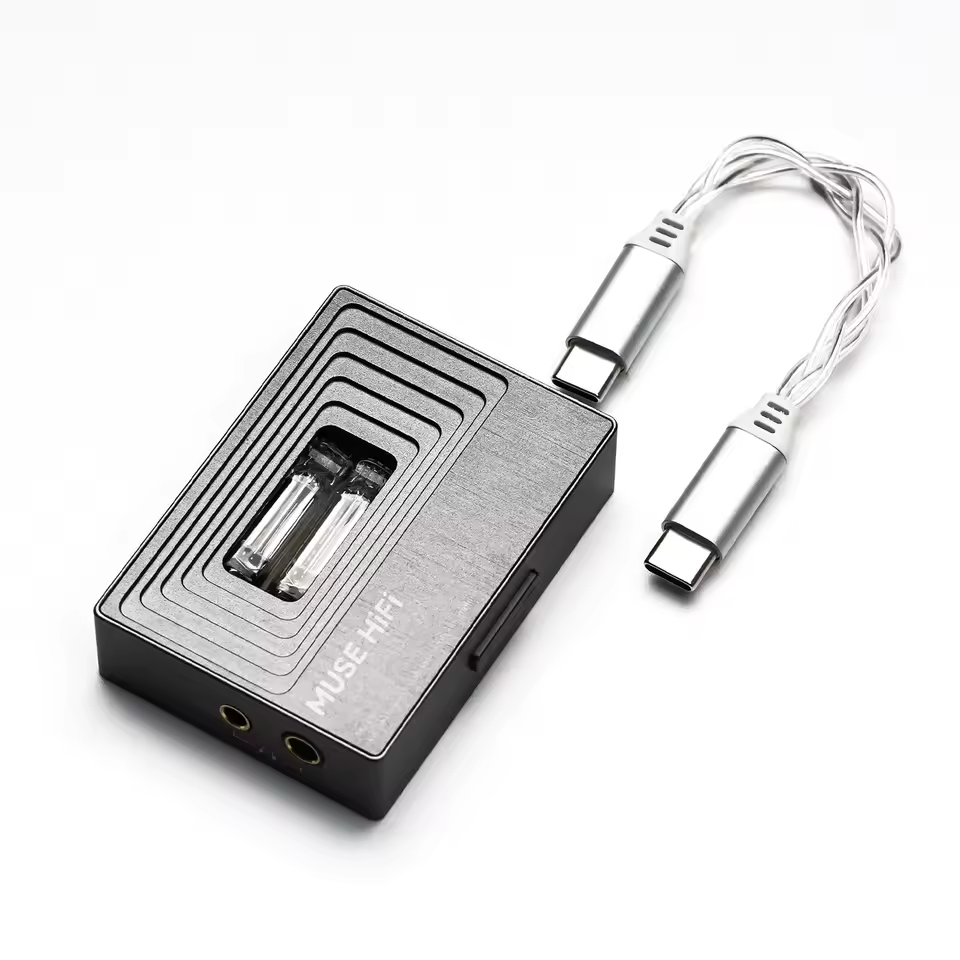
Muse HiFi M3 Ultra
To my ears, the M3 Ultra makes the most sense as a bridge between two familiar portable audio personalities. On one side is the crisp, explicit character often associated with modern ESS based dongles. On the other is the softer transient behavior, air, decay, and vocal coloration people often look for from tubes. The M3 Ultra tries to combine both rather than fully committing to either extreme.
It is also more practical than the tube concept might suggest. Power output is stated at just under 500 mW into 32 ohms, and battery endurance has been described as exceeding 12 hours. RF interference also appears unusually well controlled for this kind of design. None of that makes it a universal replacement for every high power or highly technical dongle, but it does make the M3 Ultra easier to recommend as an everyday option.
Unboxing and First Impressions
Opening the M3 Ultra is a pretty straightforward experience. Inside the package, I found the M3 Ultra itself along with a short USB Type-C to Type-C cable. A Type-C to Lightning cable is also available as an optional alternative, which is useful for older Apple devices.
The presentation is simple and practical rather than luxurious, but that fits the product well. My attention immediately went to the M3 Ultra itself, especially the visible tube section on top. It gives the device a much more distinctive look than the typical small USB dongle and makes it obvious that this is not just another conventional portable DAC/amp.
The included cable is short, which is exactly what I want for portable use with a phone. There is no oversized accessory selection or elaborate packaging here, and I do not really think the M3 Ultra needs one. At this price, I would rather see the budget spent on the DAC, amplification stage, and tube implementation than on extras that may never leave the box.
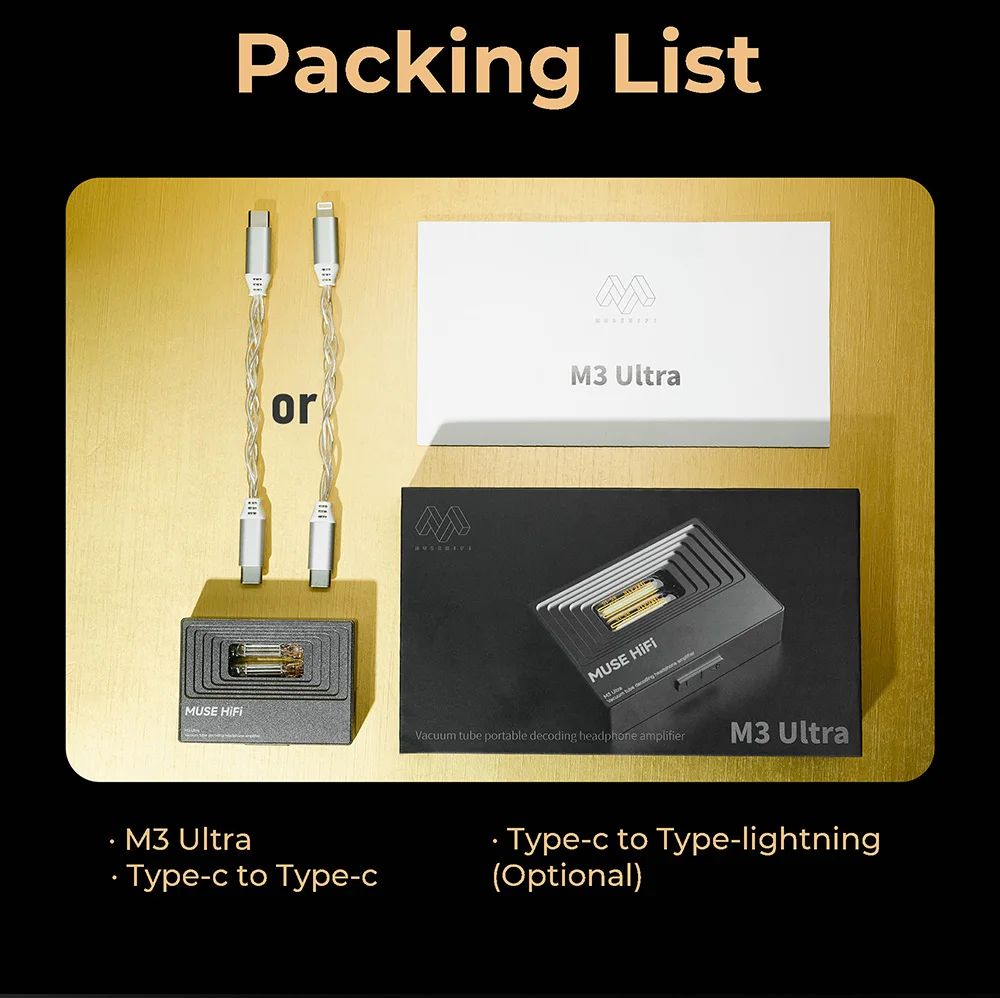
Muse HiFi M3 Ultra Accessories
Build Quality and Design
The M3 Ultra earns points for build quality, although the control layout is not perfect. One criticism I agree with is the physical button differentiation: the volume up and volume down controls would be easier to use in a pocket or in the dark if one button were raised or otherwise more tactilely distinct. That is a small ergonomic issue, but it is exactly the kind of detail that matters on a portable device.
The M3 Ultra is also positioned as a stripped down relative of Muse HiFi’s more ambitious M6 design. That framing helps explain the product: this is not trying to deliver every possible premium feature. It is trying to preserve the part that matters most - the tube flavored signal path - at a much lower price.
Sound Quality
The M3 Ultra has a clear sonic identity. I hear it as smooth, slightly relaxed in transient attack, and more interested in musical flow than in pushing every edge forward. The ESS foundation still gives it modern clarity and detail, but the tube stage takes some sharpness out of the presentation. Compared with more analytical dongles, the M3 Ultra can sound a little slower and softer, yet it does not simply erase resolution. With a resolving IEM, there is still plenty of imaging, detail, and openness.
Bass
The M3 Ultra gives me plenty of bass presence without making the low end feel exaggerated. There is good weight and impact, but it does not come across as loose or overly thick. Even with more demanding earphones, I found the bass remained convincing and well controlled.
What stands out most to me is the way the M3 Ultra handles attack and decay. Bass notes feel a little smoother and less abrupt than they do from a more typical delta-sigma dongle. That slightly softer presentation adds some warmth and body, but I still hear enough definition to follow bass lines clearly.
I would describe the overall bass character as warm, full, and forgiving rather than aggressively punchy or ultra tight. It suits the M3 Ultra’s broader presentation well, giving the sound some richness without turning it muddy or bloated.
Midrange
The midrange is where the M3 Ultra’s personality is easiest to appreciate. Vocals gain an immersive coloration, particularly female contralto and soprano voices as well as male falsetto. I hear a combination of smoothness and presence that makes voices feel less clinical without burying the information around them.
This is also where the distinction between “musical” and “analytical” becomes meaningful. Against the Nunchaku, Shanling UA7, Onyx Beta XI2, and Cayin RU9 alternatives, the M3 Ultra is framed as the more relaxed and emotionally inviting option. It is not necessarily the choice for someone who wants the hardest outlines or fastest transients, but it can be the more engaging match for vocal centric listening.
Treble
The treble is one of the areas where I notice the tube stage most clearly. It sounds smoother and less aggressive than I would normally expect from an ESS-based dongle, with sharp edges and potentially fatiguing peaks softened without making the presentation feel dull.
There is still enough air and sparkle to keep the sound open, and cymbals and higher frequency details retain a natural sense of decay. I would not describe the M3 Ultra as dark. To my ears, the treble is better described as polished and relaxed, with enough extension to stay engaging but without constantly drawing attention to itself.
This makes the M3 Ultra especially easy to listen to over longer sessions. If an IEM is already a little bright or unforgiving, I find the M3 Ultra can make it noticeably more comfortable without completely taking away its upper frequency character.
Technical Performance
The M3 Ultra is more technically capable than its smooth presentation might initially suggest. I still hear good detail retrieval, clear imaging, and a pleasantly open soundstage, especially when pairing it with more resolving IEMs.
What changes most is not the amount of information, but the way that information is presented. Transients feel slightly softer and less sharply outlined, which can make the M3 Ultra seem a little slower than a more analytical dongle. At the same time, that smoother delivery gives the sound a more natural sense of flow and decay.
I do not hear the M3 Ultra as a device that sacrifices resolution for warmth. Detail is still there, but it is presented in a less aggressive way. For me, that balance is one of its stronger qualities: enough technical performance to keep complex recordings interesting, combined with a more relaxed and musical presentation.
How It Compares
The most useful way to place the M3 Ultra is against more expensive portable dongles that chase technical precision. The Nunchaku, UA7, Onyx Beta XI2, and RU9 tend to come across as more analytical or overtly technical. The M3 Ultra instead leans into smoothness and musicality.
Power is another advantage. Output is stated at just under 500 mW into 32 ohms, enough to drive the Roseselsa x AAV CJ20 planar IEM and a wide range of demanding earphones. I would still look elsewhere for loads that genuinely require extreme power, but for most portable use the M3 Ultra appears comfortably capable.
There are also alternatives around its own price. The Protocol Max is specifically recommended for a different use case, which is a reminder that the M3 Ultra is not automatically the best choice for everyone. Its strongest comparative argument is uniqueness: if you want a modern ESS base softened by a tube stage, there is very little at roughly this price that offers the same combination.
Is It Right for You?
The M3 Ultra is for listeners who want tube flavor without moving into a large desktop setup or a much more expensive portable DAC/amp. I would put vocal listeners near the top of that list. The coloration around contralto, soprano, and falsetto voices can make singers sound immersive, while the smoother transient behavior keeps the presentation easygoing.
It also suits people with resolving IEMs who like their current level of detail but want less sharpness. The M3 Ultra does not require you to give up imaging or openness simply to get a softer presentation. That makes it a potentially strong pairing for bright, highly resolving, or slightly unforgiving earphones.
Listeners who prioritize maximum speed, hard edged separation, and an explicitly analytical presentation may prefer something like the Nunchaku, UA7, or Beta XI2. Likewise, extremely power hungry headphones are not the ideal target even though the M3 Ultra has substantial output for a dongle.
For portable tube fans, though, the balance is compelling: long battery endurance, useful power, low susceptibility to RF interference, and a sound deliberately tuned toward smoothness and musical involvement. At around $100, that combination is the reason the M3 Ultra stands apart.
Final Verdict
The Muse HiFi M3 Ultra succeeds because it does not treat tubes as a novelty. Its tube stage meaningfully changes the presentation, smoothing transients, softening sharpness, and adding an immersive quality to vocals while the ESS-based DAC retains enough resolution, imaging, and openness to keep the result from becoming vague.
There are compromises. The controls could be easier to identify by touch, the sound is not the fastest or most analytical in its class, and anyone chasing extreme power should look elsewhere. But those limitations fit the product’s priorities rather than undermining them.
What makes the M3 Ultra easy to recommend is the combination of price and character. Around the $100 mark, there is little directly comparable if the goal is a compact tube DAC/amp with strong usable output, more than 12 hours of reported endurance, good RF resistance, and a genuinely smoother musical presentation. For listeners who want portable tube flavor without paying premium dongle prices, the M3 Ultra is one of the more distinctive options in its segment.
Where to Buy
You can find the Muse HiFi M3 Ultra on:
Affiliate Disclaimer: Listen Vibes may earn commissions from qualifying purchases that helps to maintain the website - at no extra cost to you.