There are earphones made to impress and others made to perform. The Softears Studio 4 belongs firmly in the second group. Designed with professionals in mind, this four-balanced armature in-ear monitor delivers a level of precision and neutrality that makes it as much a studio instrument as it is a listening companion. Yet, despite its utilitarian philosophy, it manages to bring music to life with warmth and emotion that few reference monitors achieve.
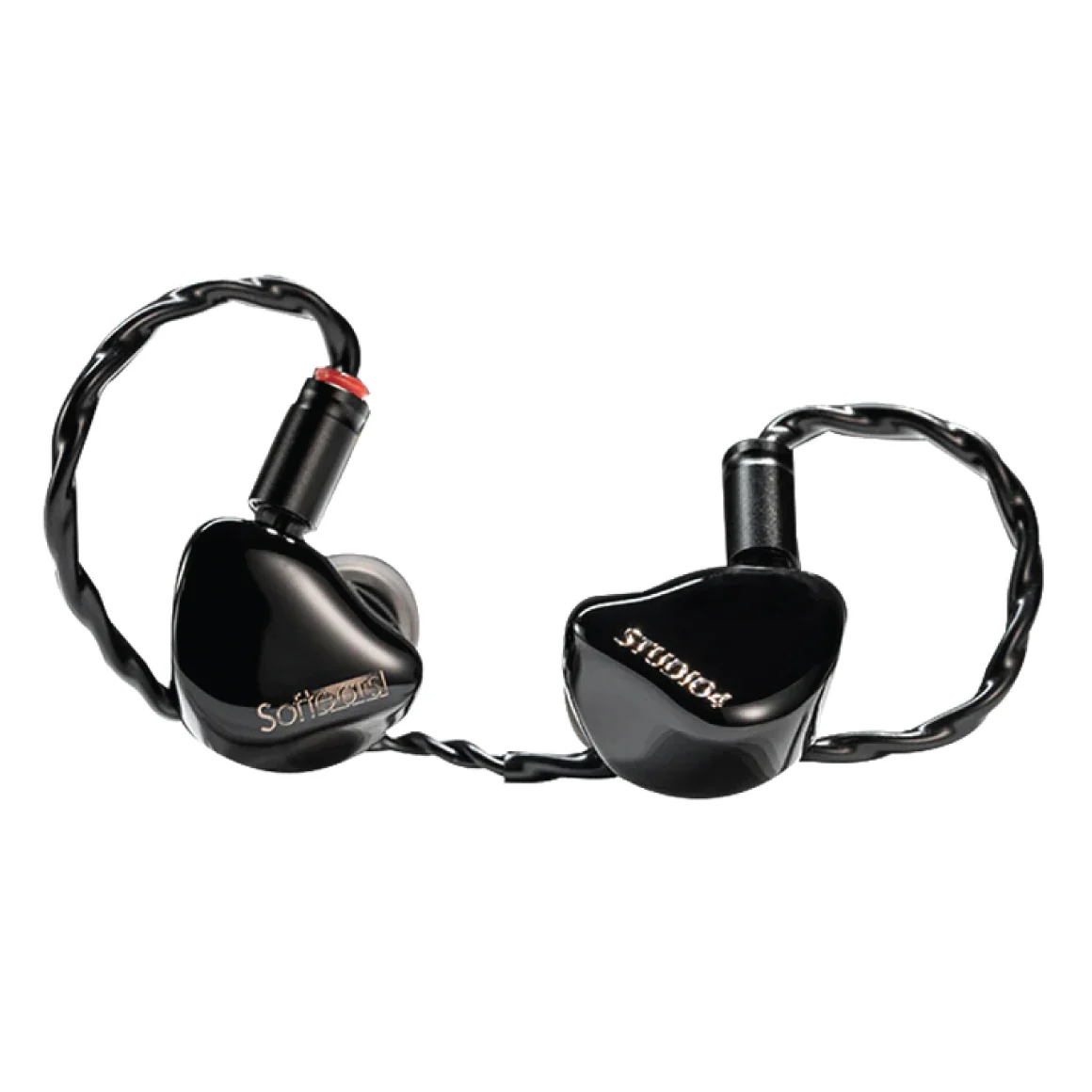
Softears Studio 4
Unboxing and First Impressions
Opening the Studio 4’s box made it clear that Softears built this model for professionals. The presentation is minimalistic, clean, and practical. The white box with simple black lettering carries an almost utilitarian charm. Inside, everything is neatly arranged: the earpieces, a rugged waterproof case, a 3.5 mm cable, multiple silicone tips, a cleaning tool, and even a long 3 m extension cable - a thoughtful addition clearly meant for studio environments.
There are no luxurious embellishments or elaborate displays here. Instead, it feels like opening a precision instrument. The leatherette case feels durable and protective rather than decorative. I like this philosophy: it tells me this IEM is designed to work-not to impress at first glance.
That said, there’s something quietly elegant about the simplicity. The black shells, the clean Studio 4 logo on the left side and Softears branding on the right, the professional-grade cable-all of it looks serious and functional, much like a high-end studio monitor or a pilot’s instrument. It gives off the same “tool for professionals” vibe that German tool watches like the Sinn 556i have: built to perform, not to dazzle.
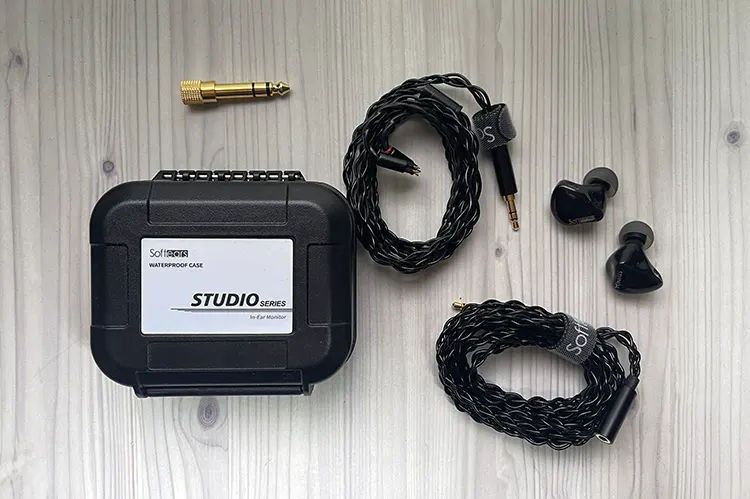
Softears Studio 4 Accessories
Build Quality and Design
The Studio 4 is a compact, lightweight IEM built entirely in black resin. The finish is smooth and understated, and the small form factor practically disappears in the ear. Comfort is exceptional - these feel like they were molded specifically for my ears. I can wear them for six to eight hours without fatigue or pressure points, which makes sense given their intended use for mixing, monitoring, and stage performance.
The nozzles feature a unique triple-port design with different acoustic filters, something I hadn’t seen before. This contributes to the Studio 4’s well-controlled and natural tonal balance. The two-pin connector feels sturdy, and the stock cable is lightweight but solid, with good flexibility and just the right amount of ear-hook tension. It’s not a “boutique audiophile” cable, but rather one that inspires reliability - again consistent with the professional theme.
Isolation is outstanding, blocking out around 75-80 % of external noise. During tests in my neighborhood and even while vacuuming, I barely heard anything from the outside world. This level of passive isolation is ideal for musicians and sound engineers who need to stay immersed in their monitoring environment.
The Studio 4 is also easy to drive. It pairs well with almost any source - from dongles to DAPs to studio mixers - and never sounded finicky or power-hungry. Its efficiency makes it versatile enough for both stage and portable use.
Sound Performance
The Softears Studio 4 uses four balanced armature drivers, and its tuning philosophy is immediately apparent: neutral, cohesive, and natural. It aims to reproduce music faithfully without exaggeration, yet it manages to do so with a level of warmth and musicality that keeps it from sounding sterile.
Bass
The bass is disciplined but satisfying. It’s not the kind of low-end that dominates the mix or shakes your skull; instead, it delivers texture, definition, and speed. There’s a tasteful emphasis on the sub-bass region that gives kick drums and synth lows a subtle rumble without bleeding into the mids. The attack is tight, decay is natural, and notes have just enough body to feel real.
Listening to Kendrick Lamar’s “DNA” or J3PO’s Bloom showcased how well the Studio 4 balances control and presence. The low frequencies have punch and clarity, never muddying the mix. It’s the type of bass that professionals trust when equalizing or mastering, but it’s also enjoyable for casual listening.
It doesn’t have the exaggerated impact of a dynamic driver, but it makes up for that with precision and texture. Every pluck of an electric bass string and every thump of a kick drum feels clean and intentional.
Midrange
The midrange is where the Studio 4 truly shines. It’s one of the most natural and believable mid presentations I’ve heard at this price point. Instruments and vocals sound organic, full, and incredibly well-balanced. There’s no artificial coloration, and no sense of a scooped-out or overly boosted presence.
Male and female vocals sit comfortably in the mix, neither too forward nor recessed. Female voices, in particular, sound stunning - smooth, airy, and lifelike, with no hint of sibilance. Tracks like Genevieve’s “Show Your Colors” and Pink Sweats’ acoustic covers made me feel like the singer was right in front of me, microphone barely an arm’s length away. That level of intimacy is something rare in studio-tuned monitors.
Male vocals, however, reveal one of the Studio 4’s few weaknesses. They sound accurate but miss a touch of lower-chest resonance - the kind of warmth that gives male voices extra depth. It’s subtle and not a deal-breaker, but it can make baritones feel slightly lean compared to how they sound on warmer sets.
Still, for instruments, the tonality is simply excellent. Pianos have the right note weight, guitars sound realistic, and strings have both texture and emotion. It’s the kind of midrange that makes long sessions fatigue-free yet deeply engaging.
Treble
Treble response is smooth and refined. Softears clearly avoided the common trap of making their balanced armature treble overly sharp or metallic. Instead, highs are clean, airy, and detailed without any harshness. Cymbals shimmer naturally, and high-frequency instruments like violins and flutes have excellent timbre.
Detail retrieval is impressive. The Studio 4 reveals micro-details effortlessly, but never in a showy way. It doesn’t force details onto you; it lets you discover them naturally. There’s enough sparkle and energy to keep things lively, yet it never crosses into fatigue territory.
The overall tonality remains cohesive from top to bottom. Bass, mids, and treble work together seamlessly, giving the Studio 4 a sense of balance that feels both accurate and musical.
Soundstage and Imaging
The soundstage is not artificially wide or deep, but it feels right. Instruments are placed precisely where they should be, and imaging accuracy is excellent. It’s the kind of spatial presentation that mirrors what you’d expect when mixing or monitoring-faithful to the recording rather than exaggerated.
The layering is clean, and each element in the mix can be distinguished easily, even in complex passages. What stands out most is the coherence-everything sounds like it belongs together. It’s immersive without being cinematic, accurate without being sterile.
Technical Performance
Resolution and detail retrieval are excellent for an all-BA design. The timbre is natural and free of the plasticky “BA sheen” that plagues many multi-armature IEMs. Transient response is quick, dynamics are natural, and tonal accuracy is among the best I’ve heard around the $500 range.
However, one caveat: the Studio 4 is not the best choice for detecting sibilance or micro-distortions during editing. It smooths out harshness so effectively that it might mask issues that more analytical IEMs would expose. For true critical editing, it’s best to cross-check with a more revealing reference like the Tanchjim Origin or an Etymotic ER4SR. But for mixing, mastering, and live monitoring, the Studio 4 hits the sweet spot between accuracy and musicality.
Comparisons
Versus Moondrop Blessing 3
The Moondrop Blessing 3 offers a brighter and more analytical sound with a higher-energy pinna gain. It highlights vocals and upper mids more aggressively, which can make it more exciting but also fatiguing over time. The Studio 4, on the other hand, is smoother, more neutral, and easier to listen to for long sessions. It trades a bit of top-end brilliance for superior timbre and tonal balance. For professional use, I’d pick the Studio 4; for those who want sparkle and excitement, the Blessing 3 remains appealing.
Versus Moondrop Variations
The Moondrop Variations delivers a deeper sub-bass and a more V-shaped profile. It’s fun and cinematic, but not as consistent tonally. The Studio 4’s mids sound far more natural and lifelike, while the Variations can feel a bit hollow in comparison. The Softears wins in midrange accuracy and long-term comfort, though the Variations might edge it slightly in soundstage width.
Versus Kiwi Ears Orchestra Lite
The Orchestra Lite shares the same all-BA architecture but sounds lighter and a bit metallic in comparison. The Studio 4 has fuller note weight, better timbre, and a more balanced tone overall. It’s the more mature and natural performer of the two, offering better bass texture and more lifelike mids.
Who Is the Studio 4 For?
The Softears Studio 4 clearly targets professionals and enthusiasts who value accuracy, coherence, and natural tone over excitement or coloration. If you work with sound - whether mixing, performing, or mastering - it’s an exceptional tool. It provides a clear window into recordings without causing ear fatigue.
For audiophiles, it’s also a wonderful all-rounder if your preference leans toward neutrality and balance. It’s not a “fun” IEM in the sense of huge bass or sparkling treble, but it’s deeply musical in a way that grows on you the more you listen. It’s one of those rare monitors that feels as much at home in a recording studio as it does during a quiet night with your favorite playlist.
Conclusion / Final Verdict
The Softears Studio 4 impressed me on almost every front. It embodies the professional ethos of precision and control while maintaining enough warmth and emotion to make music come alive. It doesn’t try to wow you with excessive sparkle or booming bass - it simply reproduces what’s there with honesty and grace.
What I loved:
- Exceptionally natural and balanced tuning
- Smooth yet detailed treble
- Realistic timbre with zero BA harshness
- Outstanding comfort and isolation
- Professional-grade build and accessories
What could be better:
- Slight lack of male vocal body and chest resonance
- Plain aesthetic might feel too utilitarian for some
- Limited detection of sibilance for critical editing
At around $450, the Studio 4 isn’t cheap, but it delivers a professional-grade listening experience that rivals much pricier options. It’s the kind of IEM that earns your trust over time-faithful, consistent, and endlessly listenable. For anyone seeking a true reference IEM that still carries a touch of musical warmth, the Softears Studio 4 is one of the finest choices available today.
Where to Buy
You can find the Softears Studio 4 on:
Affiliate Disclaimer: Listen Vibes may earn commissions from qualifying purchases that helps to maintain the website - at no extra cost to you.